

Medical Device Design & Compliance: FDA, CE Mark & ISO 13485 [2026]
Complete guide to medical device design for FDA and CE Mark approval. Device classes, ISO 13485, regulatory pathways, timelines, and costs for startups.
Complete guide to medical device design for FDA and CE Mark approval. Device classes, ISO 13485, regulatory pathways, timelines, and costs for startups.
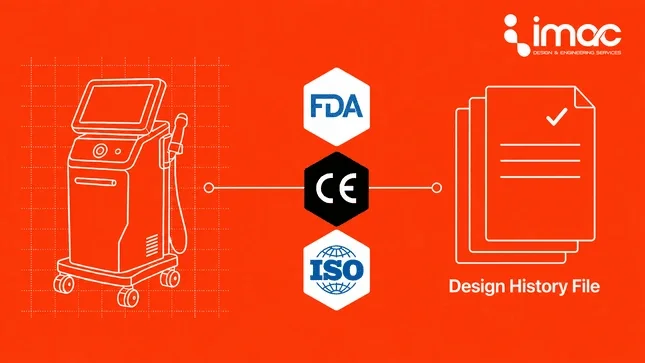
Medical device design is different.
Every decision you make has regulatory consequences. The material you select for a housing panel, the gate location on an injection-molded component, the firmware version running on a Bluetooth module. All of it falls under regulatory scrutiny. Get it wrong in consumer electronics, and you do a redesign. Get it wrong in medical devices, and patients are at risk. Your product never reaches the market.
That should not stop you from building in the medtech space. It should change how you build. Compliance has to be a structural part of your medical device design process from Day 1, not a bolt-on audit at the end.
This guide walks through what a medical device startup or R&D team needs to understand. Device classification, ISO 13485 design controls, FDA pathways, CE Mark for EU markets, risk management, and the most expensive mistakes you can make in medtech development. If you are bringing a medical device to market, whether you are a first-time founder or an engineering manager at an established life sciences company, this is where you start.
✓ Compliance is a design input, not an afterthought- Regulators evaluate your design process - not just your finished product. Build documentation and traceability from Day 1.
✓ Device classification determines everything- Your FDA pathway, timeline, cost, and testing requirements all flow from whether your device is Class I, II, or III. Know your class before you start engineering.
✓ ISO 13485 is the quality system foundation- An ISO 13485:2016-certified design partner means your Design History File is built on an independently audited framework - reducing regulatory risk from the start.
✓ Risk management belongs at the beginning- FMEA and ISO 14971:2019 risk analysis done early shapes design decisions. Done late, it becomes an expensive documentation exercise - and sometimes forces redesign.
✓ FDA clearance and CE Mark have different requirements- The FDA 510(k) relies on substantial equivalence; the CE Mark under the EU MDR places greater emphasis on clinical evidence. Plan for both if you're targeting global markets.
✓ Design verification and design validation are not the same thing- Verification checks that you built the device to spec. Validation checks that the device works for real users in the real world. Both are mandatory.
Regulatory bodies - the FDA in the United States, the notified bodies for CE Mark in Europe, TGA in Australia, PMDA in Japan - don't evaluate your finished product in isolation. They evaluate your design process. They ask: Did you follow a structured, documented, traceable design methodology? Did you identify risks and address them? Can you prove your device does what you claim it does?
This is why design and compliance are inseparable in the medical device world. If your team makes material, dimensional, or functional changes late in development without following a formal change control process, regulators consider that a red flag - regardless of how good your final product is.
The practical implication: every deliverable your engineering team produces - CAD files, tolerance analyses, BOM, assembly drawings, test protocols, and manufacturing instructions - must be documented, versioned, and traceable to your original design inputs. Regulators call that documentation package your Design History File, and it's what regulators review.
The regulatory environment for medical devices spans four major markets:
✓ FDA (USA): Enforces Quality Management System Regulation (QMSR, effective February 2, 2026), requires 510(k) clearance or PMA approval depending on device class
✓ CE Mark (EU/EEA): Self-certification or notified body review under the EU Medical Device Regulation (EU MDR 2017/745)
✓ TGA (Australia): Mirrors FDA/EU frameworks; requires inclusion in the Australian Register of Therapeutic Goods (ARTG)
✓ PMDA (Japan): Requires Shonin approval; often follows ISO standards aligned with FDA and EU requirements
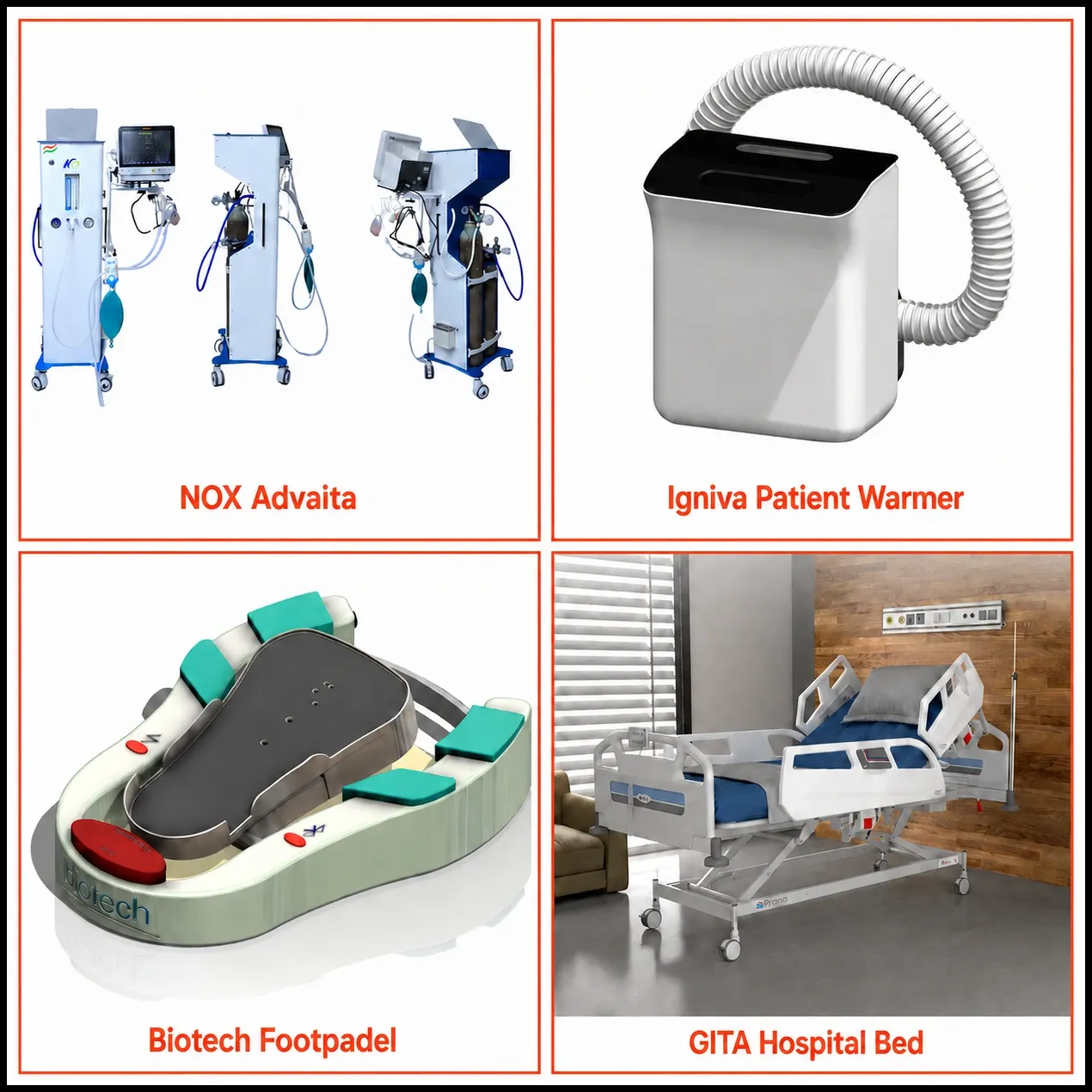
iMAC Engineering's ISO 13485:2016 certified design process is built to support clients through FDA and CE compliance pathways. Across 140+ delivered projects - including the full NOX series of nitrous oxide analgesia machines, the Igniva patient warmer, the Biotech Footpadel eye surgery controller, and the GITA Mediquip hospital bed - the same structured design controls framework underpins every medtech project we take on.
Regulatory classification determines the compliance pathway, the timeline, and the cost of bringing your device to market. Before you write a single line of CAD geometry, you need to know what class of device you're developing. The answer affects every decision downstream - from material selection to testing scope to how long you'll wait for market clearance.
What Does Class I Medical Device Classification Mean for Your Design Process?
Examples: Tongue depressors, bandages, non-electric hospital beds, handheld surgical instruments
Risk level: Minimal; no direct contact with critical body systems
Compliance pathway: General controls only. Proper labeling, manufacturing under Good Manufacturing Practice (GMP), device listing with the FDA
Documentation: Safety documentation, labeling files, manufacturing records
Most Class I devices are exempt from pre-market notification. The regulatory lift is comparatively light, but documentation is still mandatory. If something goes wrong with this device, the harm is limited and reversible.
The Igniva patient warmer, an ICU device designed to maintain patient body temperature, follows a Class I aligned process. It required rigorous product engineering and validation testing, but the regulatory pathway was structured around general controls documentation rather than full 510(k) clearance.
What Does a Class II Medical Device Design Process Look Like?
Examples: Infusion pumps, glucose meters, powered wheelchairs, dental analgesia systems, diagnostic imaging devices
Risk level: Moderate; direct interaction with body systems, potential for harm if device fails
Compliance pathway: Special controls + 510(k) Pre-market Notification (clearance pathway)
Timeline: 3–6 months post-submission (standard review)
The 510(k) process requires you to demonstrate substantial equivalence to a legally marketed predicate device. You're not proving your device is safe and effective from scratch - you're proving it's functionally equivalent to something already cleared. That predicate selection is one of the most consequential early decisions in Class II development.
The NOX analgesia machine series - NOX Artha, NOX Urja, NOX Advaita, and NOX Digital Ananta - are Class II medical devices used by dentists and pediatricians. The NOX project followed a full design-to-manufacturing workflow under ISO 13485 design controls: from design research and concept ideation through product engineering, prototyping, testing and validation, and into production with metal enclosures.
What Makes Class III Medical Device Design So Demanding?
Examples: Pacemakers, cochlear implants, heart valves, implantable neurostimulators
Risk level: High; supports or sustains human life, or prevents impairment
Compliance pathway: Pre-market Approval (PMA) - the highest regulatory burde
Timeline: 12–24+ months (includes clinical data requirements)
Cost: Typically $1M+ in regulatory costs alone
PMA requires clinical evidence, not just bench testing. You're submitting a comprehensive dossier proving your device is safe and effective. For most startups, a Class III pathway demands a specialized regulatory consultant and a significant capital commitment before any revenue is possible.
Want to reduce compliance risk before product development begins?
What About In Vitro Diagnostics (IVDs)?
IVDs have their own regulatory pathway and classification system. Classes I, II, III under IVDR in the EU, with a similar framework at the FDA. If your device tests biological samples like blood glucose, COVID antigens, or genetic markers, you are in IVD territory. That comes with distinct labeling, validation, and approval requirements.
| Device Class | Risk Level | FDA Pathway | Typical Timeline | Example |
| Class I | Low | General Controls | 2–6 months | Patient warmer, bandage |
| Class II | Moderate | 510(k) Clearance | 3–12 months | Analgesia machine, glucose meter |
| Class III | High | PMA | 12–36+ months | Pacemaker, heart valve |
| IVD | Varies | Separate pathway | Varies | Diagnostic test kits |
ISO 13485:2016 is the international standard for Quality Management Systems (QMS) specifically designed for medical device organizations. It is a certification of your design and manufacturing process, not a product certification. Regulators, contract manufacturers, distributors, and hospital procurement teams want to see ISO 13485 certification before they work with you.
Understanding ISO 13485 matters at the design stage because the standard's design controls framework dictates how your team documents, reviews, and validates every stage of product design and development.
How Does the ISO 13485 Design Controls Framework Work in Practice?
The design controls cycle maps directly to iMAC Engineering's 7-stage product development process
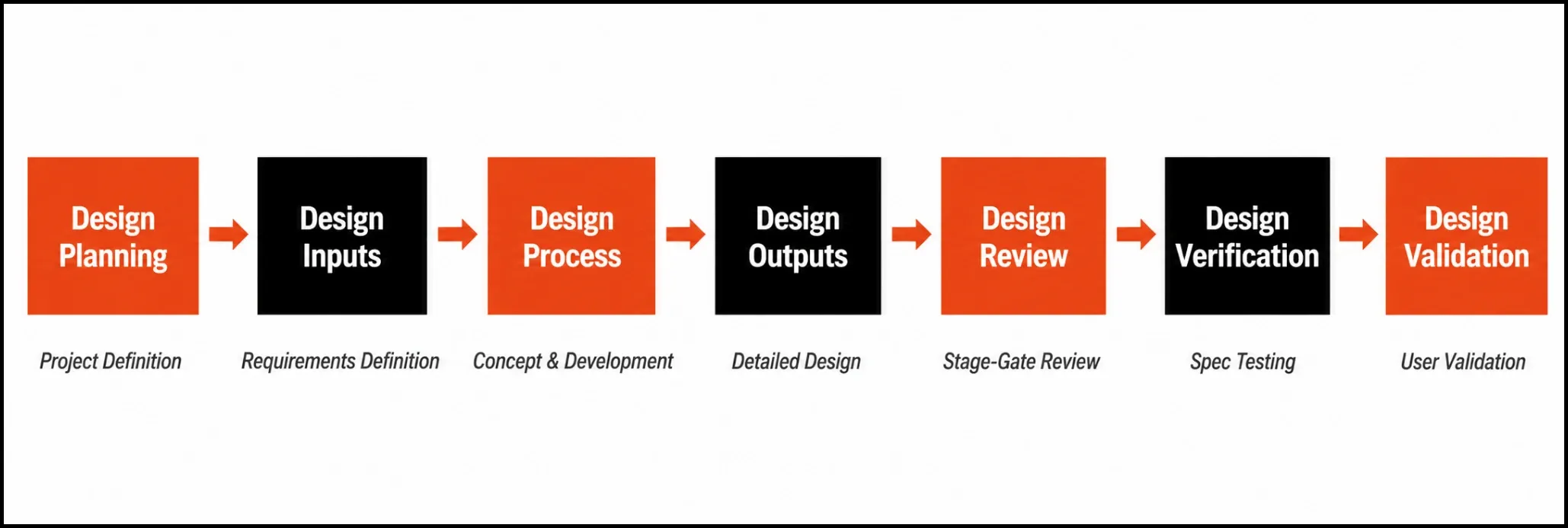
1. Design Planning
Define the project scope, team responsibilities, regulatory requirements, and key milestones. The design plan is a living document updated throughout development.
2. Design Inputs
Capture all requirements the device must meet: intended use, user needs, performance specs, safety requirements, regulatory standards, biocompatibility requirements, and environmental conditions. Poorly defined design inputs are the leading cause of failed submissions.
3. Design Process / Controls
Structured review checkpoints throughout development. Each design review must include team sign-offs, documented decisions, and identification of unresolved issues.
4. Design Outputs
Everything your engineering team produces: CAD files, assembly drawings, BOM, tolerance specifications, material specifications, manufacturing instructions, and labeling. These outputs must directly address every design input.
5. Design Review
Formal, documented reviews at predetermined milestones (typically concept, preliminary, critical, and final design reviews). These are documented evaluations with traceable decisions, not just internal meetings.
6. Design Verification
Testing that your design outputs meet your design inputs. This is the "did we build it right" check. Bench testing, dimensional inspection, electrical testing. All documented.
7. Design Validation
Proving the device meets user needs in the real use environment. "Did we build the right thing." Simulated use testing, clinical evaluation, and usability studies. Validation must use final or near-final production-equivalent devices, not early prototypes.
Also Read: Product Design and Development: A Complete Guide for 2026
What Does iMAC Engineering's ISO 13485 Certification Actually Mean for Your Project?
When iMAC Engineering says our process is ISO 13485:2016 certified, it means your project's documentation, design review records, engineering changes, and test reports are maintained in a QMS that auditors have independently verified. Your DHF doesn't start from scratch - it's built on a framework that's already been audited and approved.
For a medical device startup working toward FDA clearance, that's a material risk reduction. It means fewer documentation gaps, faster regulatory preparation, and a partner that knows what regulators expect to see before you submit.
Risk management and documentation aren't optional extras in medical device design - they're the backbone of any successful regulatory submission. Getting these right early is what separates projects that clear on the first submission from those that spend an extra 12 months responding to regulator requests. Here's what both actually involve.
What Is Risk Management for Medical Devices (ISO 14971) and When Should It Start?
ISO 14971 is the international standard for risk management in medical devices. It works hand-in-hand with ISO 13485 design controls and is required in virtually every serious regulatory submission. FDA, CE Mark, TGA.
The process follows this structure:
1. Hazard Identification: What could go wrong with this device in its intended use environment?
2. Risk Estimation: For each identified hazard, assess the probability of occurrence and the severity of potential harm.
3. Risk Evaluation: Is the risk acceptable as-is? Does it need mitigation?
4. Risk Control: Apply design changes, protective measures, warnings, or user training to reduce unacceptable risks.
5. Residual Risk Assessment: After mitigation, is the remaining risk acceptable relative to the clinical benefit?
6. Risk-Benefit Analysis: Document the overall risk-benefit conclusion.
The tool most commonly used is FMEA, Failure Mode and Effects Analysis. You systematically walk through every component and subsystem, identify failure modes, score them on severity and probability, and document your mitigation decisions. The FMEA becomes a live document updated throughout development and post-market surveillance.
What Is a Design History File (DHF) and What Should It Contain?
The DHF is the complete documentary record of your product's development. Regulators request it. Notified bodies audit it. Acquiring companies examine it during due diligence. It's your proof that you followed a structured, compliant design process.
A well-structured DHF includes:
✓ Design plan (scope, team, milestones, regulatory strategy)
✓ Design inputs (requirements, user needs, regulatory standards)
✓ Design outputs (CAD, drawings, BOM, specifications)
✓ Design review records (meeting minutes, decisions, action items)
✓ Risk management file (FMEA, ISO 14971 documentation)
✓ Verification reports (test protocols and results)
✓ Validation reports (usability studies, simulated use testing)
✓ Change control records (every documented design change with rationale)
✓ Traceability matrix (mapping inputs → outputs → verification → validation)
Critically: You build your DHF during development, not retroactively before submission. If your team hasn't maintained traceability from the start, reconstructing a compliant DHF post-development is expensive, time-consuming, and often incomplete.
Want your Risk Management File and DHF built correctly from Day 1?
Getting from concept to FDA clearance is a multi-step process that most first-time medtech founders underestimate. It is not one big submission. It is a structured sequence of decisions, testing, documentation, and review that runs in parallel with your design and engineering work. Here is how the FDA regulatory pathway for medical device approval actually unfolds.
Should You Request a Pre-Submission Meeting (Q-Sub) with the FDA Before Filing?
Before you invest in a full 510(k) submission, consider requesting a Pre-Submission (Q-Sub) meeting with the FDA. This is an optional but strategically smart step. You present your device concept, proposed predicate, and testing plan to the FDA and get their feedback before committing resources to a submission package.
Pre-subs are especially valuable for novel devices, complex software-integrated devices, or any situation where the predicate device selection is unclear. The FDA typically responds within 70 days.
How Does the 510(k) Submission Process Work for Class II Medical Devices?
The 510(k) demonstrates that your device is substantially equivalent to a predicate device already legally marketed in the US.
Your submission package includes:
✓ Device description: What the device does, how it works, intended use
✓ Predicate device selection: Identify your predicate and show substantial equivalence
✓ Comparison of technological characteristics: How your device differs from the predicate and why differences don't raise new safety or effectiveness questions
✓ Performance testing: Bench data, biocompatibility testing, electrical safety (IEC 60601 for powered devices), software validation (if applicable), sterilization validation (if applicable)
✓ Labeling: Draft IFU (Instructions for Use) and device labeling
FDA review timelines:
✓ Standard review: 90 days (FDA target)
✓ Substantive interaction: FDA may issue an Additional Information (AI) request if your submission is incomplete - this restarts the clock
✓ Total realistic timeline: 3 to 8 months from submission to clearance decision
Possible outcomes:
✓ Substantially Equivalent (SE): Device is cleared; you can begin marketing in the US
✓ Not Substantially Equivalent (NSE): FDA determines your device raises new questions; you may need to pursue PMA or reclassification
✓ Request for Additional Information: Submission is incomplete; FDA requests clarification or additional testing
What Is Design Verification and Validation (V&V) in the FDA Medical Device Approval Process?
V&V is the technical testing backbone of your 510(k) submission. It's also where many first-time medtech teams underestimate scope and cost.
Verification tests whether your design meets its defined specifications:
✓ Dimensional inspection (does the device match CAD?)
✓ Electrical performance testing
✓ Mechanical stress testing
✓ Software functional testing
✓ Environmental testing (temperature cycling, humidity, vibration)
Validation tests whether the device meets user needs in the intended use environment:
✓ Simulated use testing (using representative end users)
✓ Usability study (can clinicians operate the device safely and effectively?)
✓ Clinical evaluation (for higher-risk Class II devices, clinical data may be required)
✓ Biocompatibility testing (ISO 10993, testing device materials against biological tissues)
The difference matters: you can verify that a blood pressure cuff inflates to the correct pressure (specification met). Validation requires that a clinician can use it correctly without training errors that lead to inaccurate readings (user needs met).
Typical V&V timeline: 2 to 6 months, depending on the number of tests and availability of testing labs
Typical V&V cost: $50,000 to $500,000, depending on device complexity and regulatory class
It's worth noting that the prototyping phase directly feeds into V&V readiness. Teams that use rapid prototyping to accelerate development often reach validation-ready builds faster - which compresses the overall timeline without cutting corners.
What's the Realistic Timeline for Class II Medical Device FDA Clearance?
| Phase | Duration |
| Concept & design inputs | 1–3 months |
| Product design & engineering | 3–6 months |
| Prototyping & design iteration | 2–4 months |
| V&V testing | 2–6 months |
| 510(k) submission preparation | 1–2 months |
| FDA review | 3–8 months |
| Total (realistic) | 12–29 months |
CE marking is the declaration that your device conforms to the requirements of the EU Medical Device Regulation (EU MDR 2017/745). CE marking can be self-certified for lower-risk devices but must involve an independent notified body for higher-risk Class IIa, IIb, and Class III devices. FDA clearance, by contrast, requires government review for most devices. If you are planning to sell in both the US and European markets, you need to understand how these two pathways differ and plan for both simultaneously.
What Are the Steps in the CE Mark Medical Device Process?
1. Classify your device under EU MDR:
EU device classification rules differ from FDA classes. Understand which MDR risk class applies to your device.
2. Identify applicable standards:
Most electrical medical devices must conform to EN ISO 60601 (electrical safety). Software-driven devices must address IEC 62304. Risk management must follow ISO 14971.
3. Compile your Technical Documentation (equivalent to FDA's DHF):
Device description, design and manufacturing information, risk management file, clinical evaluation report (CER), performance testing results, labeling, and post-market surveillance plan.
4. Clinical Evaluation Report (CER):
EU MDR places significant emphasis on clinical evidence, even for many Class I devices. The CER documents the clinical evidence supporting your device's safety and performance, drawing from equivalent device data, scientific literature, and clinical investigations.
5. Notified Body review (Class IIa and above):
A notified body is an EU-designated independent organization that assesses your technical documentation and quality management system. Notified body review is mandatory for most Class IIa, IIb, and Class III devices. Currently, there is a significant bottleneck in notified body capacity under EU MDR. factor in extended timelines.
6. Issue Declaration of Conformity:
Once your device meets all applicable requirements, you issue a Declaration of Conformity and affix the CE mark.
| Factor | FDA 510(k) | CE Mark (Class IIa) |
| Government review required | Yes | No (self-certification for Class I, notified body for IIa+) |
| Clinical data typical requirement | Sometimes | Usually |
| Timeline | 3–8 months post-submission | 4–18 months (notified body availability varies) |
| Market covered | USA | EU + EEA (30+ countries) |
| Post-market surveillance | Required | Required (more stringent under EU MDR) |
These aren't theoretical design mistakes. They're what actually derail medical device projects - and extend timelines and budgets by months or years. Most of them happen early, which is exactly why catching them requires a design partner who has seen what goes wrong in real medtech development.
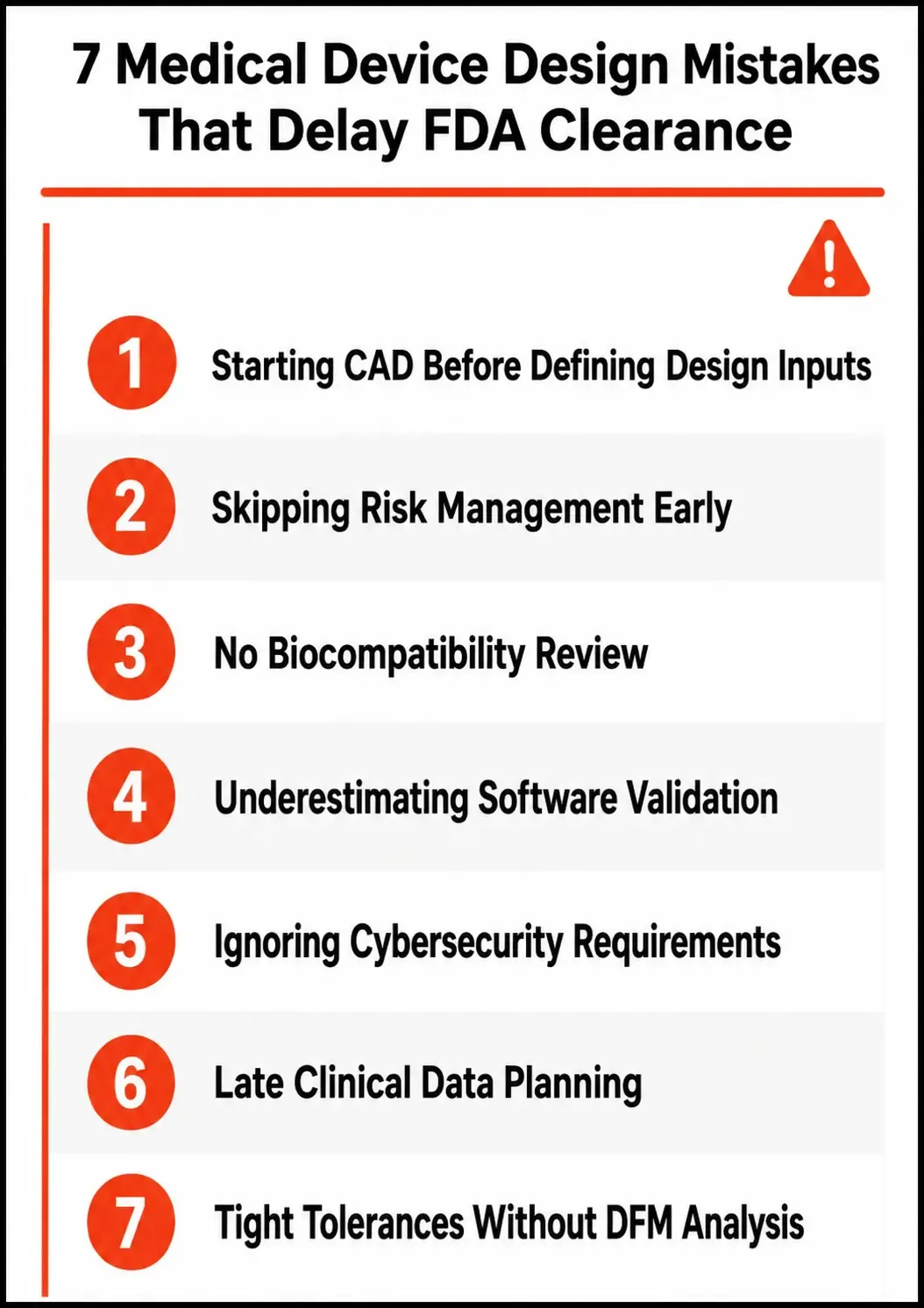
1. Starting design before defining design inputs
Teams jump to CAD before formally capturing what the device must do. When requirements change mid-design, and they always do, there is no baseline to evaluate the impact. The result is undocumented changes, traceability gaps, and regulatory submission problems.
2. Skipping risk management until late in development
Risk management done early identifies design constraints that influence every downstream decision. Risk management done late becomes an expensive exercise in justifying decisions already made. sometimes requires redesign.
3. Material selections without biocompatibility review
A plastic that performs beautifully in a consumer product may fail ISO 10993 biocompatibility testing for skin contact or device-body interface applications. Material re-selection late in development means retesting, potential tooling changes, and timeline extension.
4. Underestimating software validation complexity
If your device includes firmware, software, or connectivity, FDA and EU MDR both require software validation under IEC 62304. First-time teams consistently underestimate the documentation burden. Software functional specs, architecture, risk analysis, test protocols, and change control all add to the corresponding timeline.
5. Ignoring cybersecurity
For connected medical devices, anything with Bluetooth, Wi-Fi, cellular, or USB interfaces, FDA's Section 524B requirements (mandatory for new submissions since March 2023) require a Software Bill of Materials (SBOM), vulnerability management plan, patch plan, and cybersecurity risk management documentation. Non-compliance is a prohibited act under federal law and can result in submission rejection or enforcement action. This is not optional for new submissions.
6. Not planning for clinical data collection
For CE Mark under EU MDR, clinical evidence requirements are substantial. If your clinical evaluation strategy relies on literature from equivalent devices, plan that evaluation early. If original clinical data is needed, that adds 12 to 24+ months. Starting this conversation at the end of engineering is too late.
7. Tight tolerances without manufacturing capability analysis
A ±0.05mm tolerance on an injection-molded component that your manufacturer can only hold to ±0.15mm creates a production yield problem that becomes a regulatory documentation problem. Design for Manufacturing (DFM) review at the engineering stage prevents this.
Also Read: Design for Manufacturing: Reducing Cost and Complexity in Production
Building a medical device that cannot afford late-stage compliance surprises?
Understanding what medical device development realistically costs and how long it takes is one of the most important conversations to have before you commit resources. The numbers vary significantly by device class, but first-time founders almost always underestimate both. Here is what to expect at each stage of the process.
What Are the Realistic Medical Device Development Timelines and Costs?
A realistic timeline from concept to FDA clearance for a Class II device is 18 to 30 months, assuming no major design pivots or regulatory rejections. Accelerated programs are possible with deep regulatory experience and capital, but they are the exception.
Cost ranges:
| Development Phase | Estimated Cost Range |
| Design & engineering | $50,000–$300,000 |
| Prototyping & iteration | $20,000–$100,000 |
| V&V testing | $50,000–$500,000 |
| 510(k) submission preparation | $30,000–$150,000 |
| Regulatory consultant fees | $20,000–$100,000 |
| Total (Class II) | $170,000–$1,150,000 |
These ranges reflect the realistic scope of Class II development. Class III adds clinical trial costs. Class I is significantly less.
What Team Do You Need to Bring a Medical Device to Market?
✓ Design engineering partner (ISO 13485 certified): Takes your concept through design, prototyping, and manufacturing-ready documentation
✓ Regulatory consultant: Provides FDA/EU submission strategy, reviews documentation for regulatory compliance, and manages submission
✓ Quality engineer: Maintains the QMS, design controls, and change control processes
✓ Clinical expert (often for Class II, required for Class III): Supports clinical evaluation and validation design
Why Does Partnering with an ISO 13485-Certified Design Firm Reduce Your Medical Device Compliance Risk?
An ISO 13485 certified partner does not just follow design controls because you asked them to. Their quality system requires it. Auditors have already verified their documentation practices. When you engage iMAC Engineering for a medical device project, your DHF is built on a framework that has been independently certified. Your design reviews are documented. Your test protocols are controlled. Your engineering change requests are traceable.
For a startup approaching its first 510(k), that's not a small thing. Regulatory consultants charge for the hours they spend cleaning up documentation gaps. Every hour your team spends reconstructing a traceability matrix post-design drains budget you could have spent on clinical testing or product refinement.
iMAC Engineering has guided medical device clients from concept through validation and manufacturing across three medtech product categories. Analgesia systems, ICU equipment, and surgical instrument controllers. All under ISO 13485:2016 design controls. The NOX series went from initial design research to full manufacturing with metal enclosures. GITA Mediquip's hospital bed moved from concept engineering through full prototype testing and validation. The Biotech Footpadel eye surgery foot controller completed concept-to-validation within a structured quality system.
Navigating medical device regulatory requirements is complex - but it's not unpredictable. With the right design partner and a structured ISO 13485-certified process, you can move from concept to clearance without costly regulatory surprises.
iMAC Engineering's team has built medical devices from concept through contract manufacturing - from the NOX analgesia series to the GITA Mediquip hospital bed to the Igniva patient warmer. Every project follows the same ISO 13485:2016-certified design controls framework: documented inputs, formal design reviews, traceable engineering outputs, and validated performance.
If you're developing a medical device and want to understand what a compliant, efficient development pathway looks like for your specific device - talk to our team.
ISO 13485 is a certification of a company's quality management system, the processes used to design and manufacture medical devices. FDA approval (technically "clearance" for most devices) refers to the regulatory status of a specific device. An ISO 13485 certified company has a verified quality system that supports but does not replace FDA submission for the device itself.
iMAC's design and engineering process is ISO 13485:2016 certified, supporting clients through FDA and CE compliance pathways. Manufacturers obtain individual product FDA clearances through the FDA submission process or on behalf of the device manufacturer.
FDA targets a 90-day standard review cycle from acceptance to decision. Realistically, including the preparation of the submission package and potential Additional Information requests, total timeline from submission to clearance is typically 3 to 8 months. Total development-to-clearance timeline for Class II devices averages 18 to 30 months.
You can develop Class I medical devices for $50,000 to $200,000. Class II devices typically require $200,000–$1M+, including regulatory costs. The key is selecting an engineering partner who builds compliance into the design process - rather than paying for regulatory remediation after development.
A DHF is the complete documentary record of a medical device's design and development process, required by the FDA under QMSR and referenced in ISO 13485. It includes design inputs, design outputs, review records, verification/validation reports, risk management documentation, and change control records.
Verification answers "Did we build it right?" It tests that design outputs meet design inputs (specifications). Validation answers "Did we build the right thing?" It tests that the device meets user needs in the real use environment. Both are required. They are not interchangeable.

 Download Brochure


