

Vacuum Casting vs Injection Molding: Which Process Fits Your Production Stage?
Compare vacuum casting vs injection molding for prototypes and production. Learn how materials tooling, repeatability, and costs affect your decision.
Compare vacuum casting vs injection molding for prototypes and production. Learn how materials tooling, repeatability, and costs affect your decision.
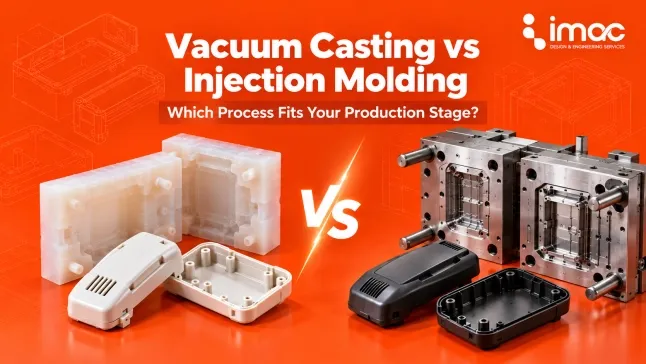
Your team needs 40 plastic enclosures for product testing. The design looks good, but you expect a few changes after customer feedback. Should you invest in an injection mold now or use vacuum casting to produce the first batch?
Now imagine the same product has passed testing, and orders are coming in regularly. Would vacuum casting still make financial sense?
The answer changes as your product moves through development.
Choosing between vacuum casting vs injection molding comes down to three things: what your product needs to prove, how stable the design is, and how many parts you expect to make.
This guide compares both processes and explains where each fits, from functional prototypes to repeat production.
Vacuum casting uses silicone molds and polyurethane resins to produce small batches of plastic parts with lower initial tooling costs. Injection molding uses metal molds and production thermoplastics, making it more economical for repeat production at sufficient volumes. Vacuum casting suits prototypes and designs that may still change, while injection molding works better when the design and demand are stable. However, vacuum-cast parts can help validate appearance and fit but cannot fully predict the material performance or repeatability of injection-molded parts.
Vacuum casting is a low-volume manufacturing process that uses silicone molds and liquid polyurethane resin to produce plastic parts. Many shops also call it urethane casting.
The process starts with a master pattern made through 3D printing or CNC machining. The shop pours silicone around the master to form a mold, then fills it with polyurethane resin under vacuum to pull out trapped air. Once the resin cures, a technician removes and trims the part.
The master's surface quality matters because imperfections can transfer to the cast parts.
Teams commonly use vacuum casting for appearance models, functional prototypes, assembly testing, and small batches. It offers lower initial tooling costs and easier design changes, but silicone molds have a limited life, and casting resins may not match the properties of production thermoplastics.
Injection molding is a manufacturing process that melts thermoplastic pellets and injects the molten material into a metal mold under high pressure. The plastic cools and solidifies before the mold opens and releases the finished part.
Manufacturers typically use aluminum or steel molds and thermoplastics such as ABS, polycarbonate (PC), and polypropylene (PP). Making the mold requires more time and investment upfront, but once it's ready, the process can produce consistent parts quickly.
Manufacturers rely on injection molding for consumer electronics housings, medical equipment and automotive components. (This also fixes “repeat production” sitting in a list of industries.). Its main advantage is efficient manufacturing at higher volumes, although tooling costs and design changes can be expensive.
For a more detailed explanation, see our guide to the plastic injection molding process.
The main difference is in the tooling and materials.
Vacuum casting uses flexible silicone molds and liquid polyurethane resins, while injection molding uses rigid metal molds and molten thermoplastics. These differences affect production costs, lead times, material options, and repeatability.
| Factor | Vacuum Casting | Injection Molding |
| Tooling type | Flexible silicone molds | Aluminum or steel molds |
| Initial investment | Lower tooling cost | Higher upfront tooling cost |
| Materials | Polyurethane resins, including rigid, flexible, and clear formulations | Thermoplastics such as ABS, PC, PP, and nylon |
| Production quantity | Small batches; limited parts per mold | Small to large production runs, depending on tooling |
| Cost per part | Generally higher due to manual work and mold replacement | Lower at sufficient production volumes |
| Design flexibility | Easier to modify by creating a new master and mold | Changes may require costly mold modifications |
| Lead time | Faster tooling preparation, but slower production per part | Longer tooling preparation, followed by faster production cycles |
| Repeatability | Can vary as silicone molds wear | Greater consistency with a controlled molding process |
Both processes can produce detailed parts with good surface finishes. The final quality depends on part geometry, material selection, and tooling accuracy.
Not sure whether vacuum casting or injection molding fits your current product stage?
A product rarely moves directly from a CAD model into large-scale manufacturing.
It typically goes through several builds, each intended to answer a different question. The manufacturing process should match what you need to validate at that stage.
For early concept models, 3D printing or CNC machining usually makes more sense. Both allow you to test a product's shape, size, and ergonomics without investing in molds. You can also make design changes quickly.
Vacuum casting becomes useful when you need several identical appearance models with a specific color, texture, or finish. Learn more in our guide to rapid vs. traditional prototyping.
Vacuum casting works well for small batches of realistic parts when the design may still change.
Teams commonly use it for assembly trials, user testing, customer feedback, investor demonstrations, and selected functional tests.
If testing reveals a design issue, you can modify the master pattern and create a new silicone mold without investing in expensive metal tooling.
These prototypes may not accurately represent the performance of the final production material.
For low-volume manufacturing, vacuum casting works well when quantities are limited and design changes remain possible. Rapid injection tooling becomes more suitable when you need production-grade thermoplastics, consistent dimensions, or molded parts for validation.
The decision depends on design stability, material requirements, expected demand, and production costs.
| Product Stage | Likely Process | Main Reason |
| Concept validation | 3D printing / CNC | Rapid design iteration |
| Functional and appearance samples | Vacuum casting | Multiple realistic parts with lower tooling commitment |
| Pilot / bridge production | Vacuum casting or rapid injection tooling | Depends on material, quantity, and validation requirements |
| Repeat production | Injection molding | Repeatability, throughput, and unit economics |
These are general guidelines, not fixed production-volume rules. Your part's geometry, material, and testing requirements can change the decision.
Vacuum casting generally has a lower upfront tooling cost, while injection molding can achieve lower per-part costs as production volume increases. Whether injection molding becomes more economical, and at what quantity, depends on the part's design, material, tooling, and total manufacturing costs.
Vacuum casting costs depend on several factors:
✓ Master pattern: The initial 3D-printed or CNC-machined part, including any surface finishing.
✓ Silicone molds: Each mold produces a limited number of parts. Larger orders may require multiple molds.
✓ Materials: Resin type, quantity, and special material requirements affect costs.
✓ Labor and finishing: Casting, curing, demolding, trimming, and inspection add to the cost of each part.
One important consideration is mold life. As production increases, you need additional silicone molds, which raises the total tooling expense. Complex geometries and difficult demolding can also affect how many usable parts each mold produces.
Injection molding requires a higher initial investment in mold design, machining, and testing. Once the tooling is ready, manufacturers can produce parts quickly with less manual work.
Multi-cavity molds can also produce several parts per cycle, improving production efficiency.
As production volume grows, the tooling cost spreads across more parts, reducing the overall cost per unit.
If demand is uncertain or the design may still change, the tooling investment may not pay off.
There is no fixed break-even quantity. A simple plastic cover and a complex enclosure with tight tolerances may become economical for injection molding at very different volumes.
Start by comparing the total manufacturing costs:
Total Vacuum Casting Cost = Master Pattern Cost + (Number of Silicone Molds × Cost per Mold) + (Quantity × Casting Cost per Part) + Additional Finishing and Inspection Costs
Total Injection Molding Cost = Metal Tooling Cost + Setup and Sampling + (Quantity × Molding Cost per Part) + Additional Finishing, Inspection, and Maintenance Costs
For vacuum casting, remember to account for mold replacements. For example, if one silicone mold produces 25 usable parts, the estimated requirement would be:
| Production Quantity | Silicone Molds Required |
| 25 parts | 1 |
| 250 parts | 10 |
| 1,000 parts | 40 |
This is an illustrative calculation, not a standard mold-life estimate. Actual output depends on material, geometry, and processing conditions.
To find your break-even point, compare supplier quotes for different quantities, such as 25, 250, and 1,000 parts. Include tooling, materials, labor, inspection, expected design changes, and future production demand.
The process with the lowest initial cost may not offer the lowest total cost over your product's manufacturing life.
Compare total manufacturing cost before choosing the process with the lowest initial quote.
Two products with the same production quantity may still need different manufacturing processes. Material properties, dimensional accuracy, and surface finish can influence the decision just as much as volume.
Vacuum casting uses polyurethane resins that can simulate the properties of plastics such as ABS and polycarbonate. Injection molding uses production thermoplastics, including ABS, PC, PP, and nylon.
However, an "ABS-like" casting resin isn't the same as actual ABS. It may look and feel similar but behave differently under heat, chemical exposure, repeated loading, or long-term use.
If your testing depends on the final material's performance, you may need parts made from the intended thermoplastic using a representative manufacturing process.
Both processes can produce detailed plastic parts, but injection molding generally offers better repeatability once the tooling and process are validated.
Vacuum casting can provide sufficient accuracy for assembly and fit testing. However, resin shrinkage, silicone mold deformation, and mold wear can affect dimensions across batches.
Injection molding also experiences shrinkage and warpage,so molded parts still need tolerance planning. For parts with snap-fits, PCB mounts, or sealing surfaces, proper tolerance analysis and inspection are essential.
✓ Surface finish: Both processes can produce smooth or textured surfaces. Vacuum casting copies the finish of the master pattern, while injection molding reproduces the mold's surface finish. Gate marks and parting lines can also affect molded parts.
✓ Mold life: Silicone molds produce a limited number of parts before replacement. Metal injection molds generally last much longer, although actual tool life depends on materials, geometry, and maintenance.
✓ Lead time: Vacuum casting typically requires less tooling preparation but takes longer to produce individual parts. Injection molding takes longer to set up initially but offers faster production cycles once the mold is ready.
Consider switching when your design is stable, production requirements are clear, and you need material properties or manufacturing consistency that vacuum casting cannot fully validate.
A successful cast prototype doesn't automatically mean the design is ready for injection molding. Some features that work in flexible silicone molds may require changes before they can be manufactured using rigid metal tooling.
Before investing in production tooling, check the following:
✓ Final CAD geometry: Confirm the design, assembly interfaces, and major dimensions.
✓ Material and functional requirements: Select the production thermoplastic and identify tests that must be repeated on molded parts.
✓ Critical tolerances: Define dimensions that affect assembly, sealing, or product performance.
✓ Design for Manufacturing (DFM): Review draft angles, wall thickness, undercuts, gate locations, parting lines, and ejection requirements.
✓ Production readiness: Confirm expected demand, tooling budget, and quality requirements.
The DFM review is particularly important. Silicone molds flex around undercuts, while rigid metal molds may need side actions or lifters to release the same geometry. Thick or uneven walls that cast successfully can also cause sink marks or warpage during injection molding.
Run a DFM review for injection molding before you make your vacuum-cast prototypes. Silicone molds forgive design problems that metal molds don’t, so checking early means you test a design that’s ready for tooling.
Yes. Bridge tooling provides an intermediate step between prototyping and long-life production tooling.
Manufacturers often use aluminum or other rapid injection molds to produce smaller batches using the intended production thermoplastic. This allows teams to evaluate molded shrinkage, warpage, assembly, and part quality before committing to long-life tooling.
Bridge tooling can also support early customer orders while the toolmaker builds production tooling.
However, it isn't always necessary. If the design is still changing, vacuum casting may remain more economical. If the design is finalized and demand is established, moving directly to production tooling may make better financial sense.
Bridge tooling can help you validate molded-part behavior before a larger tooling investment.
Both processes are useful in medical device development and consumer electronics, but their suitability depends on what the parts need to demonstrate.
Medical devices: Vacuum casting can support early enclosure testing, ergonomic evaluations, and assembly checks. However, tests involving biocompatibility, sterilization resistance, or long-term material performance may require parts representative of the final device and its manufacturing process.
Injection molding becomes important when production requires specified medical-grade materials, consistent dimensions, and validated manufacturing processes.
For example, iMAC Engineering redesigned the enclosure for a smart pill cap, a medical IoT device, replacing glued assembly with snap-fit joints and a rib-supported sealing mechanism. The team designed both within injection molding constraints, including the sink-mark risk that snap arms create, and tested snap-fit durability and sealing performance through prototype cycles. iMAC’s ISO 13485:2016-certified quality management system also supports medical device development.
Consumer electronics: Vacuum casting works well for appearance models, user testing, and electro-mechanical prototype assembly involving PCBs, batteries, or displays. Injection molding becomes more suitable when the design is finalized, and the product requires consistent quality, durable components, and repeat production.
Vacuum casting and injection molding serve different stages of product development. Vacuum casting helps you test and refine a design without a major tooling investment. Injection molding becomes more practical when the design is stable, production materials are finalized, and demand justifies the investment.
The right time to switch depends on more than quantity. Material requirements, design validation, and DFM readiness all play a role in avoiding costly changes during manufacturing.
At iMAC Design and Engineering Services, we support businesses through hardware product development, from prototyping and DFM to tooling and manufacturing. With 140+ projects delivered, our team understands the engineering decisions involved in moving a product toward production.
If you're deciding whether your product is ready for tooling, talk to iMAC Engineering.
Yes. You can use vacuum-cast parts in low-volume end-use products if the polyurethane resin meets the required strength, durability, and safety specifications. However, they may not suit applications requiring specific production thermoplastics or demanding long-term performance.
No. Vacuum casting uses liquid resin and a silicone mold to produce three-dimensional plastic parts. Vacuum forming heats a plastic sheet and uses vacuum pressure to shape it over a mold. Manufacturers commonly use vacuum forming for trays, covers, and packaging.
Manufacturers typically need CAD files, expected production quantities, material requirements, critical tolerances, surface finish specifications, and delivery timelines. Providing the same specifications for both processes helps you compare tooling costs, unit prices, and lead times more accurately.
Most silicone molds yield roughly 20 to 30 parts, though suppliers quote figures above and below that. Undercuts, complex geometry, aggressive resins and high cosmetic standards shorten mold life, so ask your supplier for a figure based on your actual part.

 Download Brochure


