

Consumer Product Design Process: From Idea to Prototype to Manufacturing
Explore the 7 stages of the consumer product design process, from idea validation and engineering to prototyping, tooling, and manufacturing.
Explore the 7 stages of the consumer product design process, from idea validation and engineering to prototyping, tooling, and manufacturing.
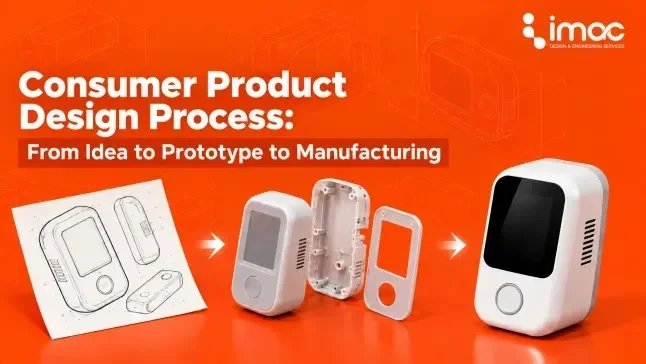
A consumer product can look great in a 3D rendering and work well as a prototype, yet face problems when manufacturing begins. Materials may cost more than expected, parts may not fit consistently, or assembly may become difficult at scale.
Good consumer product design addresses these challenges early by balancing customer expectations, usability, engineering requirements, cost, and manufacturing feasibility throughout product development
In this guide, we explain the seven stages we follow at iMAC Engineering, from validating a product idea to prototyping, tooling, and manufacturing.
Consumer product design is the process of turning a product idea into a functional, user-friendly and manufacturable product. At iMAC Engineering, this process follows seven stages: Design Research, Innovation & IP Strategy, Product Design, Engineering, Prototyping, Tooling and Manufacturing. Together, these stages help validate customer needs, refine the design, test product performance and prepare it for consistent manufacturing.
Consumer product design is the process of creating physical products that people buy and use in everyday life, from kitchen appliances and personal care devices to headphones and handheld electronics. It involves deciding how a product looks, feels and functions, what materials it uses, how much it costs to manufacture and whether it meets relevant safety requirements.
Unlike products designed for trained operators, consumer products must be easy to understand and comfortable to use without special instructions. Appearance, durability and price also drive buying decisions, so designers weigh all of them together.
How Is Consumer Product Design Different from Industrial Design and Product Development?
These terms are closely related, but they describe different areas of responsibility.
| Discipline | What it covers | Main output |
Industrial design | Form, ergonomics, user interaction, and color, material and finish (CMF) | Sketches, renders, CMF specification |
Consumer product design | Industrial design plus engineering, materials, cost targets, safety requirements and packaging | Approved design concepts, CAD models and product specifications |
Product development | Everything above plus sourcing, tooling, manufacturing, quality control and launch | Validated product ready for manufacturing or market launch |
The boundaries often overlap. For example, an industrial designer may consider manufacturing limitations while developing a concept, and a product engineer may recommend changes that improve ergonomics.
The important distinction is that a successful consumer product must satisfy both user expectations and technical requirements.
A consumer product doesn't go straight from an idea to a factory. It moves through research, design, engineering, testing, and manufacturing, with each stage addressing different requirements.
At iMAC Design and Engineering Services, the process follows seven stages grouped into three main phases:
| Phase | Stage | Question it answers | Typical output |
| Idea | 1. Design Research | Who buys it, what must it beat, and at what price? | Research summary, design brief |
| Idea | 2. Innovation & IP Strategy | What IP risks and protection opportunities exist? | Prior-art search, IP plan |
| Idea | 3. Product Design | What should it look and feel like? | Concept sketches, renders, CMF spec |
| Prototype | 4. Engineering | Will the design function and be manufacturable at the target cost? | 3D CAD, drawings, BOM, tolerance analysis |
| Prototype | 5. Prototyping | Does it work, and does it survive real users? | Prototype builds, test reports |
| Manufacturing | 6. Tooling | Is the design ready for tooling investment? | DFM report, tool design, first samples |
| Manufacturing | 7. Manufacturing | Can the line build it consistently? | Pilot run, golden sample, QC plan |
These stages aren't completely separate. Prototype testing may reveal problems that require design changes, while manufacturing requirements can influence decisions much earlier in development.
Stage 1: How Does Design Research Validate Your Product Idea?
Before investing in product design and engineering, you need to know whether your idea solves a real problem and what customers expect from it.
Design research starts with understanding your target users. Talk to potential customers, observe how they use existing products, and study competing products, their prices, features, and common complaints.
Research often changes priorities. A team planning a portable vacuum might learn that buyers care more about weight and ease of cleaning than extra features. Those findings shape size, materials and components.
The findings go into a design brief that covers target users, must-have and optional features, target retail price and unit cost, expected volume, and key usability, safety and packaging requirements. A clear brief keeps the team from building features nobody asked for.
Stage 2: Why Is Innovation & IP Strategy Important Before Product Design?
An early IP review answers two questions: is the idea actually new, and could someone else’s rights block it?
Three checks help:
✓ Prior-art search: shows whether someone has already patented your core idea and where you still have room to innovate.
✓ Freedom-to-operate (FTO) assessment: checks whether your product would infringe active patents in the markets you plan to sell in.
✓ Design protection: Considers whether your product's distinctive appearance could qualify for protection through a design patent or registered design.
Agree on confidentiality, IP ownership and who holds the CAD files before engineering starts. Our compliance and IP strategy services cover these steps.
Stage 3: How Do You Turn an Idea into a Product Design?
This is where your product starts taking shape. Using the design brief, designers explore different concepts through sketches, 3D models, and renderings, then evaluate which direction best meets customer needs and product requirements.
Consider a handheld electronic device. Its design must feel comfortable, place buttons within easy reach, and leave enough room for internal components. Designers also consider color, material, and finish (CMF), which affect how the product looks, feels, and holds up during everyday use.
But a good-looking concept isn't necessarily a practical one. We also evaluate whether the selected design can meet the target manufacturing cost without unnecessary complexity.
By the end of this stage, the team should have an approved concept, preliminary 3D models, renderings, and material recommendations ready for detailed engineering.
Have a consumer product idea that needs to become a practical, manufacturable design?
Stage 4: How Does Product Engineering Make the Design Functional and Manufacturable?
A product concept shows what the product should look and feel like. Engineering works out how its components will fit together, function, and eventually be manufactured.
For example, designing a smart handheld device means finding space for a PCB, battery, sensors, buttons, and mounting points inside a compact enclosure. Engineers also select materials, determine how parts connect, and calculate tolerances to ensure components fit and assemble correctly. These mechanical and electronic components must then work together through electro-mechanical integration and functional testing.
This is also where design for manufacturing (DFM) becomes important. If a plastic housing will be injection molded, engineers need to consider wall thickness, draft angles, and fastening methods early. Addressing these details in CAD can prevent costly changes once tooling begins.
By the end of this stage, the team should have detailed 3D CAD models, 2D engineering drawings, a Bill of Materials (BOM), tolerance analysis, and initial DFM findings ready for prototype development.
Stage 5: Which Prototypes and Tests Does a Consumer Product Need?
One prototype can’t answer every question, so teams usually build several types:
| Prototype Type | What It Helps Validate |
| Proof of Concept (PoC) | Whether the core technical idea can work |
| Looks-Like Prototype | Appearance, dimensions, ergonomics, and physical form |
| Works-Like Prototype | Functional behavior and component integration |
| EVT (Engineering Validation Test) | Does the integrated design meet its specs? |
| DVT (Design Validation Test) | Does it pass reliability, usability, and pre-compliance tests in production-intent materials? |
| PVT (Production Validation Test) | Can the production line build it to spec? |
Understanding the difference between a PoC, prototype, and MVP helps teams choose the right validation approach before committing to further engineering and production.
Methods vary. 3D printing suits shape and ergonomics, CNC machining suits specific materials and tolerances, and vacuum casting produces small runs of representative parts. Simpler products may combine EVT and DVT.
Test with real users. Hand the prototype to someone without instructions and note where they hesitate. Check fit and assembly, drop and transit performance, and cosmetics against the CMF spec. Each round usually turns up problems that never showed in CAD. Keep iterating until the test data shows the design meets its requirements.
Which safety rules apply depends on your product and where you sell it. A few common examples:
✓ US children's products: Products intended primarily for children aged 12 or younger and subject to CPSC safety rules generally require third-party testing and a Children's Product Certificate, subject to applicable exceptions.
✓ US electronics: Many digital and wireless devices must comply with FCC Part 15 requirements. Depending on the device, certification or a Supplier's Declaration of Conformity may be required before marketing.
✓ European Union: The General Product Safety Regulation (EU) 2023/988, applicable since December 13, 2024, establishes general safety requirements for consumer products, alongside applicable product-specific rules.
✓ India: Certain electronic and IT products require registration and compliance testing under the BIS Compulsory Registration Scheme.
Use these as starting points and confirm the exact requirements for your product category with an accredited test lab.
Validate the design before manufacturing turns unresolved problems into costly changes.
Stage 6: When Is a Consumer Product Ready for Tooling?
A working prototype doesn't automatically mean your product is ready for tooling. You also need to confirm that a manufacturer can produce it consistently at the required quality and cost.
Moving into tooling design and development is a significant investment, especially for injection-molded products. Once a mold is made, changing the design can mean reworking the tool, producing new samples and adding delays. That's why teams review the design and agree on a design freeze before releasing tooling.
Before moving ahead, check that:
✓ Critical prototype tests have passed and major design issues are resolved.
✓ The Design for Manufacturing (DFM) review is complete, with manufacturer feedback addressed.
✓ CAD files, engineering drawings, materials and tolerances are approved.
✓ Estimated production costs align with the target budget.
✓ Color, material and finish (CMF) specifications are finalized.
✓ A clear process exists for managing design changes after approval.
Manufacturers should be involved before the design freeze so their feedback can influence the design while changes are still easier to make.
Once the design is approved, the team can release it for mold design, fixture development or other required tooling preparations.
Stage 7: How Does a Consumer Product Move From Prototype to Manufacturing?
Production means building the same approved product consistently. The transition usually moves through tooling and fixtures, first samples, corrections and a golden sample, a pilot run, and then ramp-up once the process proves stable. Quality control continues throughout.
Demand is often uncertain at launch. low-volume manufacturing lets a team test the market without committing to large quantities. A successful prototype and a repeatable production process are different milestones, and the second one takes its own planning.
These are the factors that influence how much time and money development requires:
✓ Product complexity: More components, moving parts and complex mechanisms increase design, engineering and assembly work.
✓ Electronics and software: PCBs, batteries, sensors, firmware and connectivity add integration and testing requirements.
✓ Materials and finishes: Material selection, surface finishes and cosmetic requirements affect prototyping and manufacturing costs.
✓ Prototype iterations: Every additional design revision may require updated CAD files, new parts and further testing.
✓ Testing and compliance: Safety requirements and certifications vary by product category and target market, affecting both budgets and timelines.
✓ Tooling and production volume: Mold complexity, tooling materials and expected quantities influence upfront investment and per-unit manufacturing costs.
When you make design changes matters, too. Modifying a CAD model is generally easier and less expensive than changing a completed injection mold, which may require rework and additional testing.
We recommend planning development costs stage by stage, with clear deliverables, budgets and approval points before moving from design to prototyping and manufacturing.
A clear development plan can prevent prototype revisions and tooling changes from derailing your budget.
Two projects from our portfolio show how consumer product design decisions differ between prototype development and manufacturing.
Example 1: Mecha Comet: Consumer Handheld Computer
Mecha Comet is a modular Linux handheld computer with interchangeable extensions, including a keyboard and gamepad.
At iMAC Engineering, we supported the product from concept to a functional alpha prototype, focusing on mechanical design, component integration and prototyping.
The main engineering challenges involved fitting electronics into a compact enclosure, developing reliable interfaces between interchangeable modules, managing tolerances and maintaining comfortable ergonomics.
These requirements meant that the enclosure, internal components and modular connections had to be designed and tested together.
The project earned iMAC Engineering the Gold Award in the Product Design category at the 16th CII Design Excellence Awards 2026.
Mecha Comet demonstrates how mechanical engineering and prototype iterations help turn a complex consumer electronics concept into working hardware.
Example 2: Consumer Headphone Components
Our consumer headphone projects demonstrate how mechanical design decisions influence manufacturing costs and assembly.
In our gaming headphone mechanical design project, we developed several production-oriented features:
✓ A two-part headband with concealed joining geometry to simplify mold design while maintaining a seamless appearance.
✓ A 90-degree earcup rotation mechanism without metal hinges.
✓ A molded sliding adjustment mechanism that reduces the number of separate components.
These decisions helped simplify the mechanical structure while keeping the design suitable for injection molding and assembly.
Separately, our contract manufacturing work includes mold design and injection molding production for headphone housings.
These projects show how consumer product engineering must consider manufacturing requirements early, even when the immediate goal is to develop a functional, attractive product.
At iMAC Design and Engineering Services, we help businesses turn consumer product ideas into functional prototypes and manufacturing-ready designs. Our services cover product design, CAD engineering, prototype development, DFM, tooling and contract manufacturing.
With 140+ projects delivered, 20+ specialists and 30+ global clients, we bring practical engineering experience to consumer electronics and other hardware products. Our development processes are supported by ISO 9001:2015-certified quality management.
Whether you're starting with an idea or improving an existing prototype, we can help you plan the next stage of development.
Have a consumer product idea ready to develop? Talk to Our Team about your requirements.

 Download Brochure


