

Sheet Metal Enclosures vs Plastic Enclosures: Which Is Right for Your Product?
Compare sheet metal and plastic enclosures for electronics, including weight, durability, heat management, EMI shielding, and manufacturing costs.
Compare sheet metal and plastic enclosures for electronics, including weight, durability, heat management, EMI shielding, and manufacturing costs.
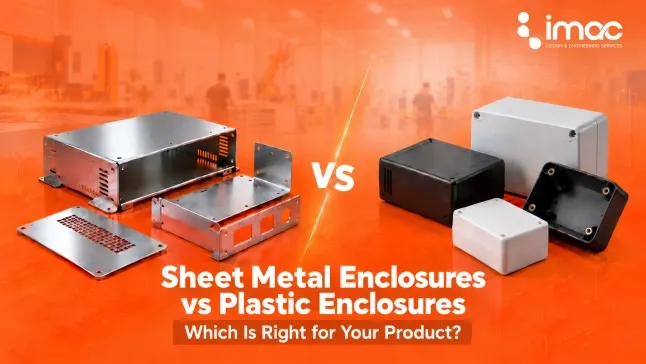
A product enclosure does more than hold components together. It protects the electronics inside, supports assembly, helps manage heat, and shapes how the finished product looks and feels.
That makes choosing the right enclosure material an important part of product development. Get it wrong, and you could face overheating, wireless interference, higher manufacturing costs, or costly design changes later.
Sheet metal and plastic are two commonly used materials for product enclosures, but each comes with its own strengths, limitations, and manufacturing requirements.
So, which one is right for your product?
This guide compares sheet metal enclosures vs plastic enclosures across performance, cost, design, manufacturing, and product development stages to help you make an informed decision.
Choose sheet metal enclosures when your product needs structural strength, heat dissipation, or EMI shielding, especially for low- to mid-volume production or designs that may require changes. Choose plastic enclosures when lightweight construction, complex shapes, or wireless connectivity are priorities, particularly for higher production volumes with stable designs. If your product needs the advantages of both materials, a hybrid enclosure may be the better choice.
A sheet metal enclosure is a protective housing made from flat metal sheets that manufacturers cut, bend, and assemble into shape. Common materials include steel, stainless steel, and aluminum, depending on the required strength, weight, and corrosion resistance.
Manufacturers typically use laser cutting, CNC bending, welding, and fastening to produce these enclosures. You'll commonly find them in industrial control panels, medical equipment, laboratory instruments, and machinery.
✓ Flat-pattern fabrication: Engineers create CAD designs that manufacturers unfold into flat patterns for cutting and bending without dedicated molds.
✓ Folded construction: Bends, flanges, tabs, and cutouts form the enclosure, while fasteners or welding join multiple parts.
✓ Material options: Steel, stainless steel, and aluminum offer different levels of strength, weight, formability, and corrosion resistance.
✓ Electrical conductivity: The metal body conducts electricity, which supports grounding and EMI shielding when joints and connections are properly designed.
✓ Surface finishing: Powder coating, anodizing, and plating can improve appearance and corrosion resistance.
✓ Mounting flexibility: Designers can incorporate brackets, threaded inserts, ventilation openings, and access panels.
✓ Lower tooling costs: Sheet metal typically requires less upfront tooling investment than injection molding, making it suitable for prototypes and small production runs.
✓ Easy design changes: Engineers can modify cutouts, bends, and mounting points without investing in new molds.
✓ Strength and rigidity: Metal can withstand mechanical loads, vibration, and the weight of heavy internal components.
✓ EMI shielding: A properly designed metal enclosure helps protect sensitive electronics from electromagnetic interference.
✓ Better heat dissipation: Metals generally conduct heat better than standard plastics, but performance varies by material. Aluminum spreads heat much more effectively than stainless steel, while actual cooling depends on the enclosure's overall thermal design.
✓ Fire resistance: Steel and aluminum are generally noncombustible, making them useful for equipment with demanding fire-safety requirements.
✓ Higher weight: Steel enclosures can make handheld and portable products heavier, although aluminum offers a lighter alternative.
✓ Limited design flexibility: Complex curves, ergonomic grips, and integrated snap-fits are harder to achieve than with molded plastic.
✓ Corrosion risk: Carbon steel requires protective coatings to prevent rust in humid or harsh environments.
✓ Higher costs at scale: Multiple fabrication and finishing operations can make sheet metal less economical than injection-molded plastic at high volumes.
✓ Wireless interference: Metal can weaken Wi-Fi, Bluetooth, and cellular signals, requiring careful antenna placement or RF-transparent sections.
✓ Electrical safety requirements: Conductive metal housings may require protective grounding, bonding, or insulation, depending on the equipment design.
A plastic enclosure is a protective housing made from materials such as ABS, polycarbonate (PC), and PC/ABS blends. These materials offer different levels of strength, flexibility, and heat resistance depending on the product's requirements.
Manufacturers typically use injection molding, 3D printing, CNC machining, or thermoforming to produce these enclosures. You'll commonly find them in consumer electronics, smart devices, IoT products, handheld instruments, and medical equipment.
Plastic enclosures provide considerable flexibility in shape, appearance, and component integration.
Their key features include:
✓ Material variety: ABS, polycarbonate, PC/ABS, and other engineering plastics offer different levels of strength, heat resistance, and durability.
✓ Molded geometry: Injection molding forms curved surfaces, ribs, bosses, snap fits, and textures in a single shot.
✓ Electrically insulating: Standard enclosure plastics do not conduct electricity, which changes how you approach shock protection and grounding.
✓ Molded-in color and finish: Color comes from pigments or masterbatch added to the plastic resin, while the mold determines the surface texture. Many molded parts don't need painting, although some require additional finishing.
✓ Grade-dependent performance: Strength, heat resistance, UV stability, and flammability all depend on the specific resin grade you choose.
✓ Lower unit costs at scale: Once manufacturers recover the tooling investment, injection molding can produce parts economically at high volumes.
✓ Lightweight construction: Plastic housings generally weigh less than metal alternatives, making them suitable for handheld, wearable, and portable products.
✓ Design flexibility: Integrated clips, hinges, and mounting features can reduce the number of separate components and simplify assembly.
✓ Corrosion resistance: Plastic does not rust, and suitable material grades can withstand humidity and exposure to many chemicals.
✓ Wireless connectivity: Most conventional plastics allow Wi-Fi, Bluetooth, and cellular signals to pass more easily than metal.
✓ Electrical safety: Their insulating properties can simplify electrical safety design, although the complete product must still meet applicable requirements.
✓ High tooling investment: Production injection molds can be expensive, and modifying them after development adds cost and time.
✓ Poor heat dissipation: Most plastics conduct heat poorly, so heat-generating electronics may need ventilation, heat sinks, or other cooling methods.
✓ Limited EMI shielding: Standard plastics provide little inherent EMI protection and may require conductive coatings or additional shielding components.
✓ Mechanical limitations: Some plastics can crack or deform under heavy loads, repeated impacts, or stress if the material and geometry are unsuitable.
✓ UV and temperature sensitivity: Certain plastics can discolor, become brittle, or deform under prolonged sunlight or extreme temperatures without suitable material grades.
Not sure whether sheet metal or plastic better fits your enclosure requirements?
The following table summarizes the main differences between sheet metal and plastic enclosures.
| Factor | Sheet Metal Enclosure | Plastic Enclosure |
| Strength and durability | High rigidity and strength; supports heavy internal components | Good impact resistance depending on material and design |
| Weight | Generally heavier, especially steel | Lightweight and suitable for portable products |
| Heat dissipation | Conducts and spreads heat effectively with proper thermal design | Poor heat conductivity; may need vents, fans, or heat sinks |
| EMI shielding | Provides effective shielding when seams and openings are properly designed | Usually requires conductive coatings or additional shielding |
| Wireless connectivity | Can weaken RF signals; may need antenna windows or external antennas | Allows wireless signals to pass with relatively little interference |
| Corrosion and environmental resistance | Depends on metal type and protective finish | Rust-free; suitable grades resist UV, moisture, and chemicals |
| Design flexibility | Suitable for bends, flanges, cutouts, and assembled structures | Supports complex shapes, snap-fits, textures, and integrated features |
| Manufacturing considerations | Lower tooling investment and easier design changes | Injection molding requires upfront tooling but can reduce unit costs at scale |
Cost is often the deciding factor when choosing between sheet metal and plastic enclosures. But the cheaper option depends on your product's design, manufacturing requirements, and expected production volume.
Tooling and setup: Sheet metal fabrication typically requires less upfront tooling investment. Manufacturers can laser-cut and bend parts using existing equipment, while injection molding requires a custom mold. Complex geometries, undercuts, and tight tolerances can increase mold costs further.
Unit price: Sheet metal fabrication costs depend on the operations required, such as cutting, bending, fastening, and finishing. Each additional operation can increase the cost per unit. Injection molding, on the other hand, can produce parts at lower unit costs once production volumes justify the initial tooling investment.
Break-even point: There is no fixed production quantity at which plastic becomes cheaper than sheet metal. The break-even point depends on part size, complexity, materials, tooling costs, and production volume.
Total manufacturing cost: Comparing unit prices alone can be misleading. You should also consider:
✓ Surface finishing, such as powder coating or plating
✓ Additional EMI shielding treatments
✓ Fasteners, inserts, and assembly labor
✓ Costs associated with design changes and tooling modifications
Low-volume plastic alternatives: You don't always need an expensive production mold for small batches. 3D printing, vacuum casting, thermoforming, and bridge tooling can offer practical alternatives depending on the enclosure's geometry and material requirements.
For a detailed comparison of manufacturing options, read our guide on low-volume manufacturing, CNC machining, and short-run injection molding.
Both enclosure types protect internal components, but they follow different design rules. Sheet metal enclosure design focuses on cutting, bending, and assembly, while plastic enclosure design must account for molding, material behavior, and cooling.
Understanding these differences early helps prevent manufacturing defects, unnecessary costs, and design revisions.
✓ Material thickness and bend radius: Choose a consistent sheet thickness for each part and suitable bend radii to prevent cracking during forming.
✓ Bend allowances and tolerances: Account for material stretching and springback to maintain accurate dimensions after bending.
✓ Holes and cutouts: Keep mounting holes and connector openings away from bend lines to avoid distortion. Add bend reliefs where necessary.
✓ Fastening and assembly: Plan mounting brackets, self-clinching fasteners, and welded joints early to simplify assembly.
✓ EMI shielding and ventilation: Design seams, joints, and ventilation openings carefully to balance shielding effectiveness and airflow.
✓ Surface finishing: Account for coating thickness and corrosion protection, particularly around mating surfaces and threaded holes.
✓ Uniform wall thickness: Maintain consistent wall thickness to reduce sink marks, warping, and uneven cooling during molding.
✓ Draft angles: Add suitable draft angles so molded parts release smoothly without damaging their surfaces.
✓ Ribs and bosses: Use ribs for structural support and properly designed bosses for mounting screws and internal components.
✓ Snap-fits and parting lines: Design snap-fits to simplify assembly and position parting lines to minimize visible marks and sealing issues.
✓ Material selection: Choose appropriate plastic grades based on strength, temperature resistance, UV exposure, and flammability requirements.
✓ Shrinkage and tolerances: Account for material shrinkage during cooling to maintain proper fit between assembled components.
The key is to consider manufacturing requirements during enclosure design, not after finalizing it. Small design decisions can affect tooling complexity, assembly, and overall production costs.
For more guidance, explore our article on common DFM mistakes and how to avoid them.
Design your enclosure around manufacturing requirements before the CAD is locked.
Your product's development stage influences how you design and manufacture its enclosure. What works for an early prototype may not be the most economical choice for full-scale production.
At this stage, the priority is to test form, fit, and functionality without spending heavily on production tooling.
✓ 3D printing: Ideal for testing plastic enclosure dimensions, ergonomics, and component placement.
✓ Sheet metal fabrication: Suitable for functional prototypes that need structural strength, heat dissipation, or EMI shielding.
✓ Off-the-shelf enclosures: A practical option when you need to test electronics before developing a custom housing.
Keep the design flexible. Early prototypes often need revisions, and investing in production molds too soon can make those changes expensive.
Once the basic design works, you need to verify how the enclosure performs under real operating conditions.
Key tests include mechanical strength, heat buildup, EMI shielding, wireless connectivity, and environmental protection.
✓ Sheet metal: Allows relatively easy modifications to cutouts, bends, and mounting features during pilot production.
✓ Plastic: Vacuum casting, bridge tooling, or prototype molds can support small batches before committing to production tooling.
Make sure prototypes represent the intended production materials and design closely enough for meaningful testing. Some prototype processes cannot fully reproduce production-part properties.
Once the design stabilizes, focus on production costs, repeatability, and assembly efficiency.
✓ Plastic enclosures: Injection molding can offer lower unit costs at higher production volumes once tooling investment becomes economical.
✓ Sheet metal enclosures: Remain suitable for industrial, heavy-duty, and customized products where strength, heat management, or shielding are priorities.
Before production, finalize CAD files, tolerances, bills of materials (BOMs), and inspection requirements. This helps manufacturers produce consistent parts and reduces costly revisions.
For more guidance, read our article on reducing product development risk before investing in tooling.
Different products have different requirements for strength, weight, thermal management, and protection. Here's where sheet metal and plastic enclosures typically work best.
| Application | Typical Choice | Why |
| Industrial control panels and power equipment | Sheet metal | Structural strength, heat management, and EMI shielding |
| Medical equipment | Sheet metal, plastic, or hybrid | Depends on cleaning, durability, weight, and electrical safety needs |
| Handheld and wearable devices | Plastic | Lightweight construction, ergonomic shapes, and integrated features |
| IoT sensors and connected devices | Plastic or hybrid | Better wireless signal transmission with options for added shielding |
| Kiosks and large equipment housings | Sheet metal or hybrid | Structural rigidity, durability, and easier customization |
| Consumer electronics | Plastic or hybrid | Design flexibility, attractive finishes, and economical high-volume production |
| Laboratory equipment | Sheet metal or hybrid | Rigid component support, durability, and thermal management |
| Outdoor equipment | Either material | Coated or corrosion-resistant metals and UV-stabilized plastics can work with proper sealing |
Some products benefit from combining both materials. For example, a connected medical device may use a metal chassis for structural support and EMI shielding, with a plastic cover that allows wireless signals to pass.
The right choice depends on which material best meets the product's functional, environmental, and manufacturing requirements.
Still deciding whether your product needs sheet metal, plastic, or a hybrid enclosure?
At iMAC Design and Engineering Services, enclosure material selection is part of the overall product development process. Our team considers product requirements, operating conditions, electronics integration, and production volume before determining a suitable design and manufacturing approach.
This connects to iMAC's seven-stage process, from Design Research and Product Design through Engineering, Prototyping, Tooling, and Manufacturing.
Our portfolio includes examples of different product development and manufacturing approaches:
✓ NOX Series: Medical nitrous oxide machines involving sheet metal enclosure fabrication and box-build assembly. The NOX Advaita redesign included welded components, rounded edges, and a powder-coated finish.
✓ Pill Cap: A medical IoT device developed from concept to injection molding production.
✓ Consumer headphones: Mold design and injection molding production for consumer product components.
With 140+ projects delivered and ISO 9001:2015 and ISO 13485:2016 certifications, iMAC supports businesses through product design, prototyping, and contract manufacturing.
Whether your product requires sheet metal, plastic, or a combination of both, the goal remains the same: choose a design that meets functional requirements while remaining practical to manufacture.
Sheet metal fabrication is often cheaper than injection molding for small batches because it doesn't require a dedicated mold. However, 3D printing and vacuum casting can make plastic enclosures economical at low volumes. The final cost depends on design complexity, materials, and production quantity.
Yes, provided you choose the right material. UV-stabilized polycarbonate and ASA can withstand outdoor exposure, while standard ABS may degrade under prolonged sunlight. Proper sealing and ingress protection are also important for keeping moisture and dust out.
Yes, but standard plastics offer little inherent EMI shielding. Manufacturers can add conductive coatings, metal plating, or conductive-filled resins to improve protection. Shielding effectiveness also depends on proper coverage, seams, and enclosure openings.
Yes. Metal can significantly weaken wireless signals, particularly when antennas sit inside a closed enclosure. Designers can address this with external antennas, plastic antenna windows, or RF-transparent sections. Planning antenna placement early helps avoid connectivity problems.
Yes. A hybrid enclosure can use a metal chassis for strength, heat management, and EMI shielding, with plastic covers for appearance and wireless connectivity. However, combining materials may increase part count and assembly costs.

 Download Brochure


