

EVT, DVT, and PVT: What Each Hardware Validation Stage Proves
Understand how EVT, DVT, and PVT help hardware teams identify design flaws, validate performance, and ensure consistent manufacturing.
Understand how EVT, DVT, and PVT help hardware teams identify design flaws, validate performance, and ensure consistent manufacturing.
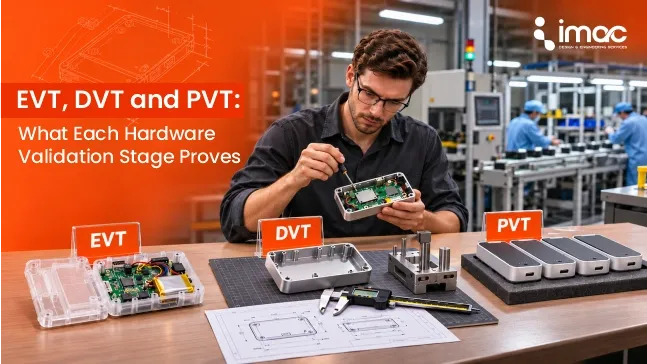
Your prototype works. It performs its intended function and looks close to the final design. But that doesn't tell you whether it can withstand real-world operating conditions, whether molded parts will behave like machined prototypes, or whether a factory can build hundreds of units consistently without excessive rework.
Engineering Validation Testing (EVT), Design Validation Testing (DVT), and Production Validation Testing (PVT) address these uncertainties at different stages of hardware product development.
Finding problems too late can be expensive. According to Formlabs, tooling modifications during production can cost up to $50,000 and cause weeks or months of delay.
This guide explains what each validation stage proves, what engineers test, what evidence is needed to move forward, and what risks remain before mass production.
EVT, DVT and PVT are the three validation builds a hardware product passes through between a working prototype and mass production. EVT (Engineering Validation Test) proves the integrated design works when built from production-intent materials. DVT (Design Validation Test) proves the final design meets every requirement using parts from production tooling, and ends in design freeze. PVT (Production Validation Test) proves the factory can build that frozen design repeatedly at target yield and speed. A stage closes only when its exit evidence is complete.
EVT, DVT, and PVT are three sequential validation stages within the New Product Introduction (NPI) process. They help engineering teams establish product functionality, design reliability, and manufacturing readiness before committing to full-scale production.
✓ Engineering Validation Testing (EVT): Does the engineering work when every component comes together in one unit?
✓ Design Validation Testing (DVT): Does the production-intent design meet its performance, reliability, usability, safety and compliance requirements?
✓ Production Validation Testing (PVT): Can your production process build that approved design repeatedly, at the quality and rate you need?
The complete hardware development sequence typically follows this progression:
Proof of Concept → Prototyping → EVT → DVT → PVT → Production Ramp-Up → Mass Production (MP)
While proof of concept and prototyping establish feasibility and explore design alternatives, EVT introduces more comprehensive engineering testing against the Product Requirements Document (PRD). Each subsequent stage uses increasingly production-representative materials, components, and processes.
Some sources use verification instead of validation in these stage names. Verification checks whether a product meets specified requirements, while validation determines whether it meets user needs and intended use. This distinction is particularly important in regulated industries such as medical device manufacturing.
The main difference between EVT, DVT, and PVT is the type of risk each stage addresses and the engineering evidence required to move forward.
| Parameter | EVT | DVT | PVT |
| Key question | Does the integrated design work? | Does the product meet its requirements? | Can we manufacture it consistently? |
| Primary objective | Engineering functionality | Product performance and reliability | Manufacturing repeatability and quality |
| Build type | Engineering prototypes | Production-intent samples | Pilot production units |
| Parts and tooling | CNC machining, vacuum casting, or prototype tooling | Representative production materials and tooling | Production tooling, final suppliers, and assembly fixtures |
| Design changes | Expected as engineering issues emerge | Controlled refinements leading to design freeze | Primarily process refinements; design changes may require retesting |
| Exit evidence | Functional test results, selected design configuration, updated CAD and BOM | Test reports against the PRD, applicable compliance evidence, and approved design | Target yield and production rate, inspection results, and approved work instructions |
| What remains unproven | Full reliability of the final product design | Manufacturing repeatability at the intended production rate | Long-term production stability across batches and lines |
EVT proves that your engineering architecture and integrated functions work as intended in one assembled unit. Instrumental, whose stage-gate guide many hardware teams use as a reference, describes EVT as the first build that combines looks-like and works-like into one form factor, using production-intent materials and processes.
Expect failures at this stage. Instrumental notes that EVT unit failure rates can reach around 40% on complex products. That's the point of EVT: it surfaces problems while changes still cost very little.
EVT focuses on how the product performs as an integrated system:
✓ Core functionality: Performance against the defined product requirements.
✓ Mechanical fit and assembly: Component compatibility, dimensional accuracy, and tolerance stack-up.
✓ Electronics and firmware: PCB functionality, sensor accuracy, connectivity, and hardware-software integration.
✓ Power and thermal performance: Power consumption, battery performance, and heat dissipation.
✓ Early reliability: Preliminary drop, durability, and lifecycle checks.
✓ Manufacturability: Initial DFM reviews and applicable compliance pre-checks.
Engineers may use CNC machining, vacuum casting, soft tooling, or 3D printing, provided the parts adequately represent the characteristics being tested.
For example, EVT for a handheld IoT device may reveal that its enclosure restricts heat dissipation or interferes with wireless connectivity, allowing engineers to refine the design before investing in production tooling.
You're ready for DVT when you can show:
✓ Core functions meet the acceptance criteria you set for EVT.
✓ Every critical failure has a documented root cause and a verified fix.
✓ You've selected one production-intent configuration.
✓ Your EVT test report records results, failure analysis and corrective actions.
✓ Updated CAD files and BOM are ready for the tooling RFQ.
Passing EVT does not establish full product reliability, regulatory compliance, or manufacturing readiness. If significant engineering changes are necessary, an additional build, often called EVT2, may be required before progressing to DVT.
Validate your hardware design before unresolved issues become expensive tooling changes.
Design Validation Testing establishes whether the production-intent product design meets its performance, reliability, usability, and applicable safety requirements. While EVT focuses on engineering functionality, DVT evaluates how the product performs under its intended operating conditions and throughout its expected service life.
Teams should commit to production tooling once they resolve critical EVT issues, stabilize the design, and complete the necessary DFM reviews.
Commit too early, and engineering changes can lead to expensive tooling modifications. Commit too late, and DVT may rely on parts that do not accurately represent the final product. Although injection-molded products often require production tooling before DVT, soft or bridge tooling may remain suitable depending on the validation requirements and production volume.
iMAC's Pill Cap enclosure redesign demonstrates why validation before tooling matters. The engineering team replaced an inconsistent glue-based assembly with a snap-fit design and evaluated insertion and extraction forces, stress distribution and sealing performance through prototype iterations before moving into injection molding production.
DVT evaluates the product against its defined requirements using production-representative samples. Typical tests include:
✓ Mechanical reliability: Drop, impact, and vibration testing.
✓ Environmental performance: Temperature cycling, humidity, and ingress protection.
✓ Durability: Lifecycle testing of buttons, hinges, latches, and moving components.
✓ Dimensional accuracy: Verification of manufactured parts against engineering drawings.
✓ Usability: Ergonomics and user interaction.
✓ Material and cosmetic quality: Material performance, surface finish, and appearance.
✓ Safety and compliance: Applicable electrical safety, EMC, and regulatory testing.
For the handheld IoT device, DVT may reveal enclosure warpage, sealing failures, or weak mounting features that earlier prototypes did not expose. For dimensional issues such as enclosure warpage, 3D scanning and CAD comparison can help engineers identify differences between manufactured parts and approved CAD models, provided the scanning method offers sufficient accuracy. This is why production-representative materials and manufacturing processes matter during DVT.
A product is ready for PVT when:
✓ Required performance, reliability, and environmental tests pass.
✓ Test reports demonstrate compliance with the PRD requirements.
✓ The engineering team resolves critical design defects.
✓ The product meets applicable compliance milestones.
✓ Engineering drawings, material specifications, and the BOM receive approval.
✓ The team establishes design freeze and formal engineering change control.
Design freeze does not prevent further changes. It means subsequent modifications require controlled approval, impact assessment, and appropriate retesting.
Passing DVT establishes confidence in the product design. Whether the manufacturing process can reproduce that design consistently at the intended production rate is what PVT must prove.
PVT proves that your intended production process can build the frozen design repeatedly, at the target quality and production rate. The focus shifts from the product to the production system around it: tooling, suppliers, equipment, operators, assembly steps and quality checks.
Teams typically conduct PVT as a pilot production run using the intended production line, manufacturing processes, suppliers and trained operators.
PVT testing typically covers:
✓ Production tooling, jigs and assembly fixtures
✓ Cycle time and throughput
✓ Supplier consistency and incoming part quality
✓ Dimensional consistency and process capability across the run
✓ Operator training and work instructions
✓ First pass yield (FPY) and defect rates
✓ End-of-line functional testing and inspection
✓ Packaging, labeling and traceability
First pass yield (FPY) is one of the most useful PVT metrics. It measures the percentage of units that meet production requirements on the first attempt, without rework or repair. If 92 out of 100 units pass the first time, your FPY is 92%. Whether that's acceptable depends on the targets you agreed on for the project.
Packaging often follows a separate development track, and PVT provides an opportunity to evaluate the complete packaged product before commercial release.
You're ready to ramp when you can show:
Close PVT with a formal production release before ramping up. During ramp-up, teams increase output, improve yield, optimize costs and qualify additional production lines, tooling or suppliers as needed.
PVT doesn't end the need for quality monitoring. New suppliers, additional production lines, tooling wear and higher volumes can all introduce new sources of variation during mass production.
Is your production process ready to deliver consistent quality as manufacturing volumes increase?
Consider a handheld IoT device with an injection-molded enclosure, electronic components and a gasket-sealed battery compartment. Here's how the same product might progress through the three validation stages.
| Stage | Build method | Example finding | Corrective action |
| EVT | CNC-machined or vacuum-cast enclosure | Overheating and poor wireless connectivity | Refine the thermal design and antenna placement |
| DVT | Production-intent molded enclosure | Enclosure warpage and gasket leakage after thermal cycling | Refine the housing and sealing design, then repeat affected tests |
| PVT | Production tooling, final suppliers and assembly fixtures | Inconsistent gasket compression and excessive assembly time | Improve component and assembly process controls, then repeat the pilot run |
The product stays the same, but each stage addresses a different source of uncertainty: engineering functionality, design reliability and manufacturing repeatability.
There's no universal build quantity or timeline for EVT, DVT and PVT. Published industry guidance shows how widely these figures can vary.
| Stage | Formlabs | Instrumental | Example duration (Formlabs) |
| EVT | About 20 to 50 units | 100–1,000 units | 3–6 months |
| DVT | 50–200 units | 300–2,000 units | 3 months |
| PVT | 500+ units or at least 5% of the first production run | 1,000–20,000 units | 1 month |
Sources: Formlabs and Instrumental. These figures are illustrative benchmarks, not fixed requirements.
A better approach is to size each build around your test plan. If your DVT plan requires six separate test groups with five units each, you'll need 30 units for those tests alone. Additional certification samples, teardown units, and spares for retesting will increase that number.
The final build quantity and timeline depend on product complexity, design configurations, destructive testing, statistical confidence, certification requirements, tooling lead times, and intended production volume.
Your test plan should determine the build quantity, not the other way around.
Most published validation frameworks focus on high-volume consumer hardware, but not every product follows the same development model.
✓ Consumer electronics: Validation emphasizes high-volume tooling, durability, cosmetic consistency, assembly efficiency, and production yield.
✓ Smart devices and IoT: Testing focuses on hardware-software integration, wireless connectivity, power consumption, and environmental resistance.
✓ Low-volume industrial equipment: Teams may use smaller or combined validation builds without compromising the required testing evidence. CNC-machined and sheet metal components may already represent the final production process. The choice of low-volume manufacturing processes directly influences the validation strategy.
✓ Medical devices: Validation adds risk management, traceability, formal design verification and validation, and controlled manufacturing processes.
The FDA's Quality Management System Regulation (QMSR), effective February 2, 2026, incorporates ISO 13485:2016 by reference. EVT, DVT and PVT can support medical device development, but they do not replace applicable regulatory or quality management requirements.
Failing a validation test is part of hardware development. Moving forward without resolving critical issues is where the real risk begins.
Each stage works as a gate, and the fix depends on where the failure came from:
| Failed stage | Typical corrective action | Confirmation build |
| EVT | Redesign, component or architecture changes, functional retesting | EVT2 |
| DVT | Design refinement, material or tolerance changes, tool modifications, regression testing on affected requirements | DVT2 |
| PVT | Tooling corrections, assembly process fixes, supplier corrective actions | Repeat pilot run (PVT2) |
Sometimes, a failure sends you back a stage. If inconsistent sealing during PVT traces back to the enclosure design rather than the gasket supplier, engineers may need to modify the enclosure and repeat the affected DVT tests before approving the revised production process.
Build time for additional testing and engineering iterations into your development schedule. Skipping essential validation doesn't eliminate risk; it transfers it to a later stage, where fixes typically cost more.
Don't let unresolved EVT, DVT, or PVT failures become costly manufacturing problems.
Moving from EVT to mass production requires close coordination between engineering, prototyping, tooling and manufacturing teams. Design changes need to carry through to tooling, and manufacturing feedback needs to reach engineers before it becomes a production problem.
At iMAC Design and Engineering Services, our seven-stage product development process connects these activities under one roof. Our support spans each validation stage:
With 140+ projects delivered, 20+ specialists and ISO 9001:2015 and ISO 13485:2016 certifications, iMAC supports hardware startups, SMEs and OEMs from concept through manufacturing.
Whether you're planning your first EVT build or working through an unresolved validation issue, connect with our team.
Product design and engineering teams typically lead EVT. DVT requires collaboration between engineering, quality, testing, and manufacturing teams. The contract manufacturer or internal manufacturing team generally leads PVT, with the product owner and relevant stakeholders approving the production release.
Yes, provided the units meet all applicable product specifications, quality requirements, regulatory obligations, and commercial release criteria. Some businesses retain PVT units for field trials, internal evaluation, or future quality investigations instead of selling them.
Not necessarily. Product variants that share the same engineering architecture and manufacturing processes may use common validation evidence where technically justified. Changes to materials, dimensions, electronics, or critical components may require additional testing to address variant-specific risks.

 Download Brochure


