

CNC Machining vs Sheet Metal Fabrication: Which Process Fits Your Part?
Compare CNC machining vs sheet metal fabrication by geometry, tolerance, cost, and volume. See which process fits your part from prototype to production.
Compare CNC machining vs sheet metal fabrication by geometry, tolerance, cost, and volume. See which process fits your part from prototype to production.
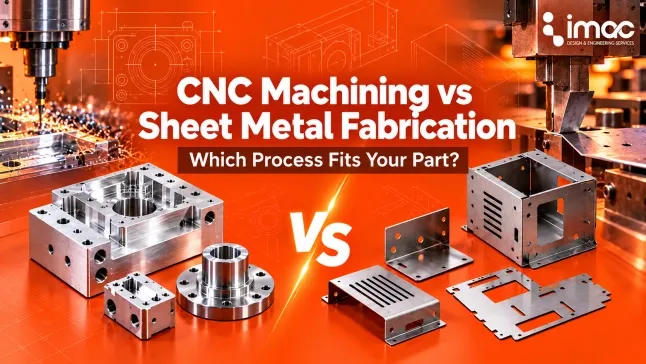
A metal bracket can be made in two ways. You could machine it from a solid block of aluminum or cut and bend it from a metal sheet. Both methods might produce a part that looks similar, but the manufacturing costs, material use, and dimensional accuracy can be quite different.
That's why choosing between CNC machining vs sheet metal fabrication isn't simply about which process is better. The right choice depends on your part's geometry, tolerance requirements, material, and production quantity. A process that works well for a functional prototype might not be the most practical option for production.
This guide compares both methods and explains how to select the right process for your metal parts.
Choose CNC machining when your part needs variable wall thickness, tight tolerances on bores or mating faces, or true 3D features like pockets and internal passages. Choose sheet metal fabrication when your part has a uniform thickness and can unfold into a flat pattern, such as enclosures, brackets, panels, and chassis. Neither process is always cheaper. Geometry, tolerances, production quantity, and assembly requirements determine the cost. Some products benefit from combining both processes. For final design validation, use production-representative prototypes wherever the manufacturing process affects fit, strength, or performance.
The main difference lies in how each process shapes metal. CNC machining removes material from a solid block, bar, or plate, while sheet metal fabrication cuts and forms flat metal sheets into the required shape.
This difference determines the types of parts each process can produce, along with their tolerances, material requirements, and manufacturing costs.
CNC (computer numerical control) machining uses programmed cutting tools to remove material from a block, bar, or plate. CAM software converts your 3D model into toolpaths, and the machine follows them to cut the final geometry.
The most common operations include:
✓ CNC milling: Rotating cutting tools remove material to create pockets, slots, holes, and complex surfaces.
✓ CNC turning: The machine rotates the workpiece against a cutting tool to produce cylindrical parts such as shafts, pins, and spacers.
✓ Drilling and tapping: These operations create holes and threads directly in the solid material.
CNC machining works well for solid components, complex 3D geometries, and parts requiring precise fits. However, extensive material removal and complex machining operations can increase manufacturing costs.
Sheet metal fabrication uses cutting, bending, forming, and joining operations to turn flat metal sheets into finished components.
The typical process involves:
✓ Cutting: Laser cutting, punching, or shearing creates the flat blank, along with holes, slots, and vents.
✓ Forming: A press brake bends the blank along straight lines to create flanges, channels, and box shapes.
✓ Joining: Welding, riveting, or fasteners connect multiple pieces into an assembly.
✓ Hardware insertion: Self-clinching nuts, studs, and standoffs add threaded points without any machining.
✓ Finishing: Powder coating, painting, anodizing, or plating protects the part and sets its appearance.
Engineers can model these parts as sheet metal bodies in CAD and generate flat patterns using bend allowances suited to the material, thickness, and forming process.
Sheet metal fabrication can produce lightweight, stiff components efficiently when the part's geometry suits cutting and forming. Its limits come from the forming itself. Standard press brake bends typically follow straight lines. Sheet metal generally retains nearly uniform thickness, although forming can introduce thickness changes and dimensional variation.
Both processes manufacture functional metal components, but they offer different capabilities.
| Comparison Factor | CNC Machining | Sheet Metal Fabrication |
| Starting material | Solid block, bar, or plate | Flat metal sheet |
| Manufacturing method | Removes material through cutting | Cuts, bends, forms, and joins metal |
| Suitable geometry | Solid parts, pockets, bores, and complex 3D features | Panels, enclosures, brackets, and bent structures |
| Wall thickness | Can vary throughout the part | Generally uniform within each sheet component |
| Dimensional accuracy | Suits precise features and tight fits | Accurate cut features; bends introduce variation |
| Material utilization | Can generate significant waste during material removal | Efficient nesting can reduce material waste |
| Low-volume production | Suitable for prototypes and small batches | Suitable using laser cutting and standard bending tools |
| High-volume production | Scalable, with costs influenced by machining time | Can benefit from efficient forming and dedicated tooling |
| Design changes | CAD, toolpaths, and setups may need updates | Flat patterns and bend requirements may need updates |
| Surface finish | Controlled machined surfaces; finishing may be required | Original sheet finish, with possible cut or bend marks |
| Common applications | Bearing housings, shafts, manifolds, and fixtures | Enclosures, brackets, panels, and chassis |
These are general differences. Actual tolerances, costs, and lead times depend on the material, part geometry, production volume, and manufacturing equipment.
Not sure whether CNC machining or sheet metal fabrication better fits your part?.
Start with what your part needs to do. Geometry, tolerances, material, and assembly requirements help determine which manufacturing process makes sense. Once you've identified the technically suitable options, you can compare their costs.
Start with one test: Can your part be made from a flat sheet of uniform thickness?
✓ If yes, consider sheet metal fabrication. Enclosures, brackets, covers, panels, and chassis are common examples. Bends and flanges can add stiffness without increasing material thickness.
✓ If not, consider CNC machining. Deep pockets, internal channels, thick bosses, and varying wall thickness often make machining a more practical choice.
Take an electronics enclosure. Cutting and bending aluminum sheet can produce a similar housing with much less material removal than machining it from a solid block. A bearing housing, on the other hand, often favors CNC machining because of its thick sections and precision bores.
Sheet metal designs also need suitable bend radii, hole clearances, and forming allowances. During iMAC Engineering's NOX Advaita redesign, rounded corners created challenges with sheet metal bending and tooling alignment, requiring the team to balance appearance with manufacturability.
Ultimately, the part's geometry should guide the initial process selection, but functional requirements determine the final choice.
CNC machining generally offers tighter control over critical features such as bearing bores, mating surfaces, and precision holes. Sheet metal fabrication can also achieve accurate dimensions, but bending introduces additional variation.
Three factors explain why:
✓ Springback: Metal partially returns toward its original shape after bending, so bend angles vary slightly from part to part.
✓ Material variation: Small batch-to-batch changes in sheet thickness and hardness affect the final bend.
✓ Tolerance stack-up: Each bend adds its own small error. A dimension measured across three bends carries more variation than one measured across a single flat face.
For example, a laser-cut hole may have a tighter tolerance than the distance between two holes positioned across several bends.
Here's where costs can increase unnecessarily. Specifying tight tolerances across an entire part may require additional machining or inspection, even when only a few features need precision.
The better approach is to apply tight tolerances to functional features and use appropriate general tolerances for noncritical dimensions. Confirm achievable values with your manufacturer before finalizing the design.
Both processes work with the common engineering metals: aluminum, mild steel, and stainless steel. The real difference lies in how each alloy behaves in each process.
✓ 5052 aluminum forms well and makes a strong choice for sheet metal enclosures.
✓ 6061 aluminum generally machines well but can crack at tight bend radii, particularly in harder tempers such as T6.
✓ Stainless steel fabricates well as sheet, though it needs more bending force. Austenitic stainless steels such as 304 and 316 can work-harden during machining, increasing tool wear and making machining more demanding.
✓ Mild steel suits both processes and keeps cost low for general brackets and housings.
CNC machining is often more practical for thick, solid components with complex features. Sheet metal fabrication can also handle thicker plates, but bending them requires greater force and suitable equipment.
Structure matters too. A machined part can be made from one solid piece without welded or fastened joints, which may benefit components carrying concentrated loads. Sheet metal gets its stiffness from geometry. Flanges, ribs, and bends add rigidity with relatively little weight, making it suitable for enclosures, frames, and panels.
Surface finish: CNC machining gives you a controlled finish straight off the tool, and you can specify roughness face by face. Sheet metal can retain its supplied surface finish or receive additional treatment, such as brushing, painting, powder coating, or anodizing for suitable aluminum alloys.
Assembly: CNC machining can combine multiple features into one solid part. A sheet metal design often splits into several bent parts that welds, rivets, or fasteners hold together. More parts can mean more assembly time, but they also make large, light structures possible.
Threads: A threaded hole doesn't automatically mean you need CNC machining. Sheet metal parts commonly use self-clinching nuts, rivet nuts, and welded nuts or studs to add strong threaded points. On the NOX Advaita wheel assembly, the team welded a cylindrical nut with internal threads onto the sheet metal body to secure the wheel. That one detail solved both the exposed-nut appearance problem and the wheel retention requirement.
Use this table as a starting point. Your part's geometry, tolerances, and structural requirements can change the recommendation.
| Metal Part | Usually Preferred | Why | Watch Out For |
| Electronics or PCB enclosure | Sheet metal | Uniform walls, vents, and cutouts | Holes placed too close to bends |
| Kiosk body or large panel | Sheet metal | Large, lightweight structures | Panel flatness and weld distortion |
| L-shaped or U-shaped bracket | Sheet metal | Simple geometry with one or two bends | Hole alignment after bending |
| Machine covers and guards | Sheet metal | Lightweight protective structures | Sharp edges and mounting clearances |
| Bearing housing or precision mount | CNC machining | Precise bores and mating features | Bearing fits and bore alignment |
| Shaft, pin, or spacer | CNC turning | Cylindrical geometry | Diameter tolerances and runout |
| Manifold or fluid block | CNC machining | Internal passages and sealing features | Intersecting passages and sealing |
| Precision jig or fixture | CNC machining | Accurate locating and mounting features | Over-tolerancing noncritical surfaces |
| Chassis with precision mounting points | Hybrid | Sheet metal structure with machined interfaces | Alignment between mating components |
These are typical recommendations, not fixed rules. A simple bracket may need CNC machining for complex features, while some fixtures can be fabricated from sheet metal. The final choice depends on the part's functional requirements.
Choose CNC machining or sheet metal fabrication based on what the part actually needs to do.
Neither process is always cheaper. A large, hollow enclosure may cost less to fabricate from sheet metal, while a compact part with complex features may be more economical to machine from solid stock.
The final cost depends on geometry, tolerances, material, finishing, and production quantity.
CNC machining and sheet metal fabrication costs come from different manufacturing operations.
CNC machining:
✓ Raw material and material removal: You pay for the starting stock and the time spent removing excess material. Parts requiring extensive cutting can increase both waste and machining time.
✓ Machining time and setup: Multiple setups or re-fixturing to reach different faces add cost.
✓ Tooling, fixtures, and complex features: Deep pockets, small internal radii, and hard materials may require specialized tools or slower cutting.
✓ Precision requirements and inspection: Tight tolerances can increase finishing and measurement time.
Sheet metal fabrication:
✓ Material utilization and nesting: Efficiently arranging parts on a sheet reduces waste, while poorly nested shapes increase material costs.
✓ Cutting, bending, and forming: More cuts, bends, and complex forming operations increase processing and setup time.
✓ Welding, fasteners, and assembly: Each weld, inserted fastener, or additional assembly step adds cost.
✓ Surface finishing and tooling: Coating and special forming tools add costs when required. High-volume stamping may justify dedicated dies.
At low volumes, both processes can be economical. A simple two-bend bracket may favor sheet metal fabrication from the first batch, while a complex solid component may be better suited to CNC machining.
As quantity increases, both processes spread setup costs across more parts. Sheet metal can gain further advantages through efficient nesting, repeatable forming, or dedicated stamping tools at higher volumes. CNC machining also benefits from optimized setups and batch production.
No fixed crossover quantity exists. A simple two-bend bracket may favor sheet metal from the first batch, while a complex solid 3D part may remain better suited to CNC machining regardless of production quantity. For a closer look at how quantity affects manufacturing decisions, read our guide to low-volume manufacturing.
The right choice depends on your product's development stage and what you need to test.
Early prototypes: CNC machining suits parts that will stay machined in production and parts that still need frequent design changes, since toolpath edits are quick. Sheet metal prototypes can also be produced quickly through laser cutting and press brake bending, often without dedicated production tooling.
Small batches and pilot runs: For suitable formed parts, sheet metal fabrication may become more economical as setup costs are spread across larger batches. Both processes still handle design changes reasonably well at this stage.
Production: Sheet metal scales efficiently for enclosures, brackets, and panels. CNC machining can remain suitable for precision components even at higher volumes, depending on geometry, tolerances, and production requirements.
For a broader view of how prototyping methods compare on cost and speed, see our post on rapid vs traditional prototyping.
Not always, especially during early development. But as you move toward design validation, your prototypes should represent the intended production process wherever it affects performance.
For example, a machined enclosure may confirm basic dimensions and electronics placement, but it won't fully reveal springback, bend-related tolerances, weld distortion, or the stiffness of the final sheet metal structure.
A machined substitute can work for early form-and-fit checks. However, before approving the design for production, test prototypes made using the intended materials, forming operations, and assembly methods.
This helps identify manufacturing problems before committing to production tooling.
Not every product fits neatly into one manufacturing process. Combining both makes sense when sheet metal can provide the main structure, while certain features require CNC machining.
For example, a sheet metal chassis can provide a lightweight structure, while CNC-machined bearing mounts or locating blocks handle precision requirements. This avoids machining an entire chassis just to achieve a few accurate features.
If you're converting a machined part into a hybrid design, three approaches can help:
✓ Replace a hollow machined housing with a folded sheet metal structure.
✓ Add flanges or ribs to improve stiffness without increasing material thickness.
✓ Use small machined inserts for precision bores or mounting points.
iMAC Engineering's NOX Series nitrous oxide analgesia machines demonstrate this approach. The project combined metal enclosure fabrication, component machining, and full assembly across four product variants. Coordinating these operations through box build assembly also helps manage fit and alignment between components.
Before choosing a hybrid design, compare the machining savings against any additional fastening and assembly costs.
Before requesting a manufacturing quote, confirm these requirements:
Critical tolerances: Which features need tight tolerances, and which can follow general tolerances?
Material and thickness: Does the selected alloy and material thickness suit the manufacturing process?
Production quantity: How many parts do you need initially, and what volumes do you expect later?
Design maturity: Is the design finalized, or do you expect further changes?
Finish and assembly: Are there specific coating, appearance, welding, or fastening requirements?
Inspection needs: Do you need dimensional reports, first article inspection, or material certificates?
Next, prepare the manufacturing files. CNC machining typically requires a STEP file and a 2D drawing with critical dimensions, tolerances, threads, and surface finish requirements.
Sheet metal fabrication generally requires a formed 3D model, drawings showing material thickness and bend details, and a DXF flat pattern if requested by the manufacturer. Multi-part assemblies may also need a bill of materials (BOM) and assembly drawings.
Finally, conduct a Design for Manufacturing (DFM) review to identify costly features or potential production issues before requesting final quotes. If your drawings aren't ready, iMAC Engineering's mechanical CAD drafting services can help prepare manufacturing documentation.
Compare total manufacturing cost before choosing the process with the lowest initial quote.
At iMAC Design & Engineering Services, choosing the right manufacturing process starts with a Design for Manufacturing (DFM) review. Our team evaluates part geometry, materials, tolerances, and assembly requirements to identify costly features and potential manufacturing issues before production.
Through our contract manufacturing services, we support CNC/VMC machining, sheet metal fabrication, prototyping, and assembly. This allows us to recommend machining, fabrication, or a combination of both based on the part's requirements.
With 140+ projects delivered and ISO 9001:2015 and ISO 13485:2016 certifications, iMAC supports product development from engineering through manufacturing.
Not sure which process fits your part? Talk to Our Engineering Team.
Yes. Many sheet metal shops use CNC-controlled laser cutters, punch presses, and press brakes. CNC refers to computer-controlled machine operation, not a specific manufacturing process. CNC milling and turning remove material from solid stock, while sheet metal fabrication involves cutting and forming metal sheets.
Yes. Thin sheet metal commonly uses self-clinching nuts, rivet nuts, welded nuts, or studs to create threaded connections. Thicker sheets can also accommodate directly tapped holes. The best method depends on sheet thickness, thread size, loading requirements, and assembly access.
Yes, certain features can achieve ±0.05 mm with suitable equipment and process controls. However, maintaining this tolerance across multiple bends is much more difficult because of springback and material variation. Critical features may require secondary machining or precision inserts. Always confirm achievable tolerances with your manufacturer.
Sometimes. The same 3D model can serve as a starting point, but each process has different design requirements. CNC machining needs suitable tool access, while sheet metal fabrication requires uniform thickness, bend allowances, and an accurate flat pattern. Some solid models can be converted directly; others need redesigning before manufacturing.

 Download Brochure


