

9 Benefits of Reverse Engineering in Product Development
Explore the top benefits of reverse engineering in product development, from recovering lost CAD to cutting costs, reducing risk, and accelerating redesign decisions.
Explore the top benefits of reverse engineering in product development, from recovering lost CAD to cutting costs, reducing risk, and accelerating redesign decisions.
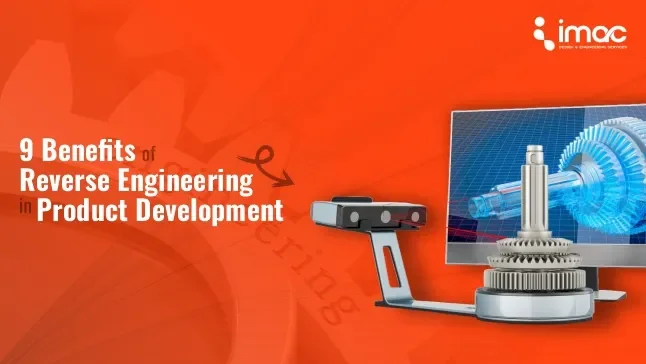
If you hold a physical part but you don’t have reliable CAD, drawings, tolerances, or supplier information, reverse engineering becomes your fastest route back to control. It is not 'copying'. But it is one strategic process that captures geometry, GD&T intent, and functional interfaces, so you can decide reverse engineering vs redesign with confidence. Done right, there are many benefits of reverse engineering that include a reduction in rework, sourcing time, and protecting fit/function in production.
Yes, that's true, so let's talk about how it actually works.
✓ Reverse engineering is a detailed process. The goal is not copying but to understand design intent and manufacturability.
✓ Its #1 benefit is de-risking: reducing delays, obsolete parts, and redesign errors.
✓ It accelerates development by providing a verified, physical starting point, impacting timelines by 30-75%.
✓ It preserves critical knowledge from legacy equipment and retiring experts.
✓ Build a disciplined reverse engineering process: define datums → capture data → model intent → validate critical features → confirm manufacturability
✓ Use reverse engineering vs redesign as a strategy: reverse engineer interfaces to protect fit/function, redesign where you need performance or cost change.
Reverse engineering in product development is the systematic process of deconstructing a physical object to uncover its design intent, manufacturing methods, and functional performance. It uses 3D scanning, precision metrology, and engineering analysis to create a verified digital CAD model, which is then used for reproduction, redesign, validation, or troubleshooting.
Key Insight :
Scan ≠ reverse engineering
A scan gives you a mesh or point cloud. Reverse engineering will convert that raw geometry into design intent and manufacturing truth. Without datums, GD&T logic, and validation, you don’t actually have a production-ready definition, but maybe you just have a “perfect shape.”
Reverse engineering vs redesign: a simple decision rule
Use reverse engineering when the current part already works, and you must preserve fit/function (legacy parts, obsolescence, spares, tooling, mating interfaces).
Use redesign when you must change performance, cost structure, safety factors, materials, or process route significantly.
In many projects, teams often do both: reverse engineer the interfaces, redesign the rest.
Benefit 1: Recover missing CAD and drawings so you can manufacture again
Reverse engineering gives you back the core asset you need to produce: a verified digital definition.
This is the most common reason leaders invest in it because delays or sourcing gaps cost more than the reverse engineering effort.
Where does it work the best?
✓ Legacy machines with no OEM support
✓ Parts with lost/incorrect drawings
✓ “Tribal knowledge” parts that only one supplier understands
Measurable outcomes you can expect
✓ Faster RFQs (because suppliers quote faster from clean CAD + controlled dims)
✓ Reduced downtime risk (spares availability improves)
Smart move? Build an inspection-first model strategy. Identify the 10–20 dimensions/features that actually control fit/function, then model around them. This prevents teams from over-modelling irrelevant surfaces.
Benefit 2: Create "digital twins" of prototypes & hand-built parts
It captures the "as-built" state of a successful prototype, turning a one-off into a reproducible, manufacturable product.
Your R&D team makes a perfect functional prototype by hand. It's filed, tweaked, and adjusted. But there's no CAD to send to production.
We scan the "hero" prototype, model it, and apply manufacturable tolerances. This bridges the "high risk period" between R&D and production, ensuring the first production run matches the proven prototype.
Benefit 3: Reduce development cost by cutting prototype loops and rework
Reverse engineering lowers cost because you stop iterating blindly. You start from the real geometry, and you validate critical dimensions early.
Cost drivers it reduces :
✓ “We’ll fix it in prototype #3” cycles
✓ Tooling rework because the CAD didn’t match reality
✓ Scrap due to uncontrolled tolerance assumptions
Quality cost context (why this matters financially)
ASQ defines cost of poor quality (COPQ) as the costs associated with providing poor quality products or services.
That’s the area where reverse engineering helps you shrink because you detect a mismatch earlier and build measurable inspection gates.
Practical example pattern
✓ Reverse engineer interfaces → lock fit
✓ Redesign internal geometry → optimize cost/process
✓ Validate first articles → prevent mass scrap
Looking for a Reliable Partner for Reverse Engineering Services?
Benefit 4: Accelerate competitive analysis & benchmarking
It provides a quantified, measurable understanding of how a competitor's product is designed and manufactured, informing your own design decisions.
Beyond guessing, you can physically measure a competitor's part wall thickness, material density (via testing), and assembly methods. You learn they use a snap-fit (which saves 30 seconds of assembly time) or a thinner gauge that may fail under specific loads. This isn't to copy, but to benchmark and innovate past them with hard data.
Benefit 5: Allows rapid, informed redesigns
It provides a perfect, as-built digital starting point for modifications, ensuring your redesign fits and functions with existing systems.
This is a key decision point for reverse engineering vs redesign. Need to add a mounting boss to an existing assembly? Don't start from old 2D drawings that may be wrong. Reverse engineer the actual assembly to get a perfect fit. This avoids costly fit/function errors and tolerance mismatches in the first build, slashing iteration cycles.
Benefit 6: Improve reliability by finding hidden wear, drift, and failure modes
Reverse engineering helps you see what changed over time, especially in fielded parts. This is the brilliant thing in product development because you can compare:
✓ “As-designed” intent (or what you believe it was)
✓ “As-built” reality
✓ “As-worn” geometry from failures/returns
Strategy that works the best
✓ Measure wear patterns (ovality, taper, runout zones).
✓ Tie geometry drift to root causes (misalignment, heat, lubrication, vibration).
✓ Feed that into design changes or process controls.
This is how reverse engineering improves reliability!
Benefit 7: Facilitate Smooth Integration & Modernization
It allows you to design new subsystems that interface perfectly with old, undocumented equipment.
Upgrading the control panel on a legacy machine? Reverse engineer the mounting surface and connector locations to design a drop-in replacement. This eliminates custom fabrication and installation risk.
Benefit 8: Preserve undocumented(essential information)& standardize parts
It captures the design embedded in decades-old, shop-floor-modified equipment and creates standardized CAD for future use.
That machine with 20 years of undocumented welds and brackets? The legacy operator knows it inside out. Reverse engineering captures that "undocumented information" in a digital format before it is lost. You can then standardize the parts across your fleet, simplifying maintenance and purchasing.
Benefit 9: Ensure Regulatory & Compliance Documentation
It generates the required "as-built" documentation for safety certifications, audits, and regulatory compliance when original paperwork is missing.
Industries like aerospace (FAA), medical (FDA), and energy (ASME BPVC) require documentation. If you need to certify a legacy system, reverse engineering provides the technical data package, detailed drawings, materials analysis, and load paths necessary for compliance, avoiding forced decommissioning.
Important boundary :
You should use reverse engineering for understanding, interoperability, and improvement, not for violating IP. A responsible team treats it as an engineering discovery plus risk-managed development!
Need a structured reverse engineering process that protects fit, function, and compliance?
The main objective is to recreate a reliable technical definition from an existing product so you can manufacture, inspect, maintain, or improve it. It’s especially useful when original drawings are missing, suppliers change, parts go obsolete, or you must preserve fit/function while making controlled updates.
Reverse engineering accelerates development while reducing cost and risk. It helps you recover CAD, preserve interfaces, shorten RFQs, enable second sourcing, improve QA through validation, reduce downtime exposure, and support DFM improvements without breaking performance. It also gives clarity on reverse engineering vs redesign because you can isolate what must remain unchanged.
It reduces cost by cutting rework, avoiding extra prototypes, and preventing scrap caused by bad assumptions. When you start from measured reality and validate critical features early, you avoid late-stage fit failures, tooling changes, and supplier disputes. You also shrink quality losses by defining measurable inspection gates instead of relying on “it looks right.”
Reverse engineering delivers the strongest ROI when you treat it like a strong strategic approach.
At iMAC Engineering, we run reverse engineering the way production teams need it. We choose the right capture method (CMM, structured light, laser), rebuild CAD with datum logic and GD&T awareness, and validate critical-to-function features before you spend on tooling or volume orders. You get deliverables you can use right away: CAD drawings your suppliers can quote from, inspection checks your QA team can measure, and clear next steps to manufacture.

 Download Brochure


