

Reverse Engineering vs Redesign: Which Is Right for Product Development?
Explore the differences between reverse engineering and redesign in product development. Learn which approach best suits your project and business goals.
Explore the differences between reverse engineering and redesign in product development. Learn which approach best suits your project and business goals.
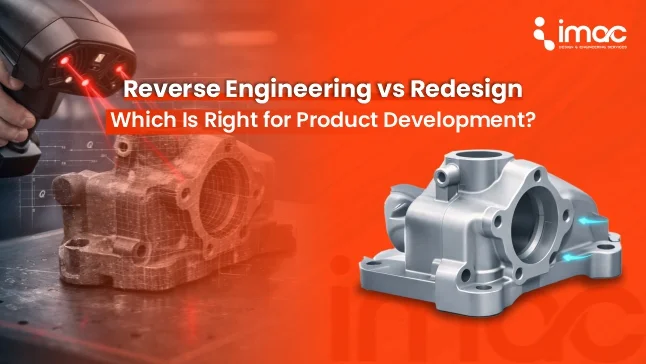
Your product needs improvement but where do you start? Should you take it apart to understand what works, or rebuild it from the ground up? Reverse engineering vs redesign represents a important decision in product development. One focuses on understanding existing solutions; the other reimagines them entirely.
This choice shapes your timeline, budget, and final outcome. For manufacturers, medical device makers, and aerospace companies working with legacy systems or competitive pressures, picking the right approach saves months and investment.
✓ Reverse engineering captures "what is" (replication), while redesign creates "what could be" (innovation).
✓ Choose reverse engineering when CAD data is lost or never existed. Choose redesign when performance, cost, or manufacturability must be improved.
✓ Reverse engineering is essential for legacy part reproduction and competitive analysis. Redesign is key for part consolidation and performance optimization.
✓ Reverse engineering and redesign to get a baseline CAD model, then redesign it for improvement.
✓ Reverse engineering is typically faster to a CAD file; redesign takes longer but aims for a superior final product.
✓ The choice depends on intent solving a data gap or a performance gap not on technological preference.
Reverse engineering is the process of deconstructing a physical object to understand its design, function, and composition. You start with the end product a legacy part, a competitor's component, or a prototype and work backward to create a digital 3D CAD model.
Reverse engineering is used when you need to replicate, document, validate, or improve an existing product without changing its core functionality.
The goal is not to create something new, but to accurately capture what already exists.
Key benefits of reverse engineering :
1. Cost efficiency
The cost matters most when time is tight. Reverse engineering costs less than full redesign because you're working from an existing reference, not inventing from scratch. Your team spends hours scanning and documenting, not months researching and iterating.
2. Recover lost design data
Many manufacturers face challenges due to incomplete or unavailable design data. In fact, nearly three-quarters of engineering and manufacturing companies report being held back by disconnected or incomplete data systems, underscoring why reverse engineering is essential for rebuilding digital design foundations.
3. Enable legacy part reproduction
When original tooling or suppliers are gone, you can recreate exact CAD models for manufacturing.
4. Perform competitive analysis
Understand how a product is built, its materials, and tolerances without any proprietary documents.
5. Create documentation for un-documented parts
Essential for maintenance, repair, and overhaul (MRO) in aerospace and heavy manufacturing.
6. Form a basis for future redesign
The captured 3D model is the perfect starting point for analysis and subsequent improvement.
7. Shortens development product lifecycle
Analyze integrate proven, market approved features from existing products. This allows you to pass foundational R&D phases, accelerating your own time-to-market significantly.
8. Mitigates pre launch risk
By studying the physical successes and failures of existing products, you gain critical, real-world insight. This reduces the uncertainty and potential for costly errors in your own development, acting as a form of validation before you commit to tooling.
9. Enables smart competitive analysis
It is not just about copying. It’s a strategic tool to understand your competitor's design choices why they used a certain material, how they achieved assembly efficiency, or where they might have compromised. This intelligence informs your own design decisions, helping you compete more effectively.
Inshort you need to deeply understand reverse engineering when you need to understand, replicate, or digitally preserve a physical object. It’s a recovery and discovery approach.
Redesign is the intentional process of re-imagining and re-creating a product or component to improve its performance, manufacturability, cost, or aesthetics.
While it may start with an existing concept, the outcome is a new design. This process leverages engineering analysis (like Finite Element Analysis or CFD), modern materials, and advanced manufacturing techniques (like DfAM - Design for Additive Manufacturing).
Key benefits of redesign :
Improve Performance & Function: Address weaknesses, reduce weight (critical in aerospace), or enhance thermal/structural efficiency.
Reduce Manufacturing Cost & Complexity: Simplify assembly, consolidate multiple parts into one (through part consolidation), or switch to a more cost-effective material or process.
Incorporate New Features or Technology: Update an old product to meet new market demands or integrate with modern systems.
Overcome Obsolescence: Replace obsolete components with modern, readily available alternatives.
Enhance for Modern Production: Optimize a design for CNC machining, injection molding, or 3D printing to improve yield and quality.
| Aspect | Reverse Engineering | Redesign |
| Primary goal | Replication & understanding | Improvement & optimization |
| Design data | Recreated from physical part | Modified from existing logic |
| Risk level | Lower (known outcome) | Medium to high |
| Time to market | Faster | Longer |
| Mindset | "What is this and how is it made?" | "How can we make this better?" |
| Output | Accurate digital CAD model (As-built) | New, improved digital CAD model |
| Key driver | Lack of data, need for a digital copy | Poor performance, high cost, new requirements |
| Regulatory impact | Minimal change | Often significant |
| Best for | Legacy parts, replacements | Performance or cost upgrades |
The key insight: Difference between reverse engineering and redesign is the difference between improving what exists and imagining what could be.
The right choice on reverse engineering vs redesign comparison depends on your specific situation. Here's how to decide
1. Choose Reverse Engineering When:
The CAD model is lost or never existed - This is the most common reason. You have a drawing or a part, but no 3D file for manufacturing or analysis.
You need to analyze a competitor's product - Understand their design choices, tolerances, and potential manufacturing methods.
You must reproduce a legacy part - The original supplier is out of business, but equipment still needs spare parts.
You have physical prototype to digitize - A model or hand-shaped prototype needs to be converted into a manufacturable CAD file.
You need "As-built" documentation - For quality control or to document deviations from the original design in manufactured assemblies.
2. Choose Redesign When:
The current design is underperforming - It fails, is too heavy, inefficient, or doesn't meet new regulatory standards (common in the Medical Device Industry).
Manufacturing costs are too high - The design is complex to produce, has high scrap rates, or uses expensive materials/processes.
You need to integrate new components or technology - Modernizing a product line in the consumer electronics or automotive industry.
The goal is part consolidation - Combining several assembled pieces into a single, stronger, and easier-to-produce component, often using 3D printing.
You're designing for a new manufacturing process - Switching from casting to machining, or from traditional fabrication to additive manufacturing.
In practice, many projects start with reverse engineering and transition into redesign especially in aerospace, automotive, and medical device programs.
Consumer Electronics: Analyzing competitor devices for tear-down reports, recreating housings for aftermarket accessories, or recovering designs for out-of-production gadgets.
Medical Device Industry: Creating CAD models of existing surgical tools or implants for regulatory documentation, or to analyze and improve upon them. It's important for maintaining legacy medical equipment.
Aerospace Industry: A cornerstone of MRO (Maintenance, Repair, Overhaul). Digitizing worn or damaged turbine blades, airframe components, and cockpit interfaces for precise repair or remanufacturing when original specs are unavailable.
Automotive Industry: Reproducing classic car parts, analyzing competitor components, or capturing the complex geometry of intake manifolds or body panels for aftermarket or repair purposes.
General Manufacturing: The most common use case - recovering the design of a worn-out jig, fixture, or molding tool that is critical to production but has no digital backup. It ensures manufacturing continuity.
Explore our structured reverse engineering process to understand how accuracy is maintained across stages.
Choose reverse engineering when the goal is to replicate or validate an existing product without altering its function.
Redesign is better when performance, cost, manufacturability, or compliance needs improvement. If the product works but no longer meets business or regulatory goals, redesign delivers long-term value.
Yes. Many projects begin with reverse engineering to capture accurate design data, then move into redesign to improve specific aspects. This combined approach reduces risk while enabling innovation.
Reverse engineering is typically faster because it works within existing constraints. Redesign takes longer due to testing, validation, and possible tooling changes but offers greater improvement potential.
Choosing between reverse engineering vs redesign is not about which method is more advanced it’s about what the product actually needs right now.
For teams in aerospace, medical devices, automotive, and manufacturing, this clarity is important. It prevents wasted time and budget. Start by asking the fundamental question: "Is our core problem a lack of data, or is it a lack of optimal performance?" The answer points directly to your path.
At iMAC Engineering, we've guided manufacturers, medical device companies, and aerospace organizations through both paths. Let's talk about what your product needs and which approach gets you there faster.

 Download Brochure


