

Importance of User-Centred Design in Product Development
Learn what user-centered design is, its key principles, process, and why it’s essential for creating successful, user-friendly, and market-ready products.
Learn what user-centered design is, its key principles, process, and why it’s essential for creating successful, user-friendly, and market-ready products.

User-centered design in product development has emerged as the cornerstone of successful product innovation in 2025.
This methodology places users at the heart of every design decision through three excellent approaches: empathy-driven research that uncovers real user needs, iterative prototyping that validates assumptions early, and data-driven testing that ensures optimal usability.
Modern design practices now integrate user feedback loops throughout development cycles, while companies increasingly focus on systematic user validation processes.
This blog explores the essential elements of user-centered design, from foundational principles to measurable outcomes, providing actionable strategies for teams seeking to build more effective and engaging products.
✓ User-centered product design prevents costly design mistakes by aligning solutions with real user needs.
✓ The iterative process - research, prototyping, and validation pushes both usability and sustainable product design outcomes.
✓ Applying design guidelines from cognitive science ensures intuitive, inclusive, and emotionally engaging experiences for users.
✓ Embedding UCD reduces risks, boosts market fit, and strengthens ROI, whether in-house or via outsourcing product design.
✓ Success is measurable with usability metrics, sustainability KPIs, and business ROI indicators for long-term impact.
User-Centered Design (UCD) in product development is a design philosophy and methodology that prioritizes users' needs, preferences, and limitations throughout the entire product development lifecycle.
According to Interaction Design Foundation, UCD involves involving users throughout the design journey from research to evaluation, to create usable, accessible, and meaningful products.
Unlike a technology‑first or feature‑first approach, UCD applies principles from cognitive science and human factors so that users aren’t forced to adapt to your product; instead, the product adapts to them.
In practice, UCD in product development ensures that sustainable product design concerns (materials, lifecycle, recyclability) and outsourcing product design decisions don’t override real user needs. Too often, product design mistakes happen when assumptions replace user insights.
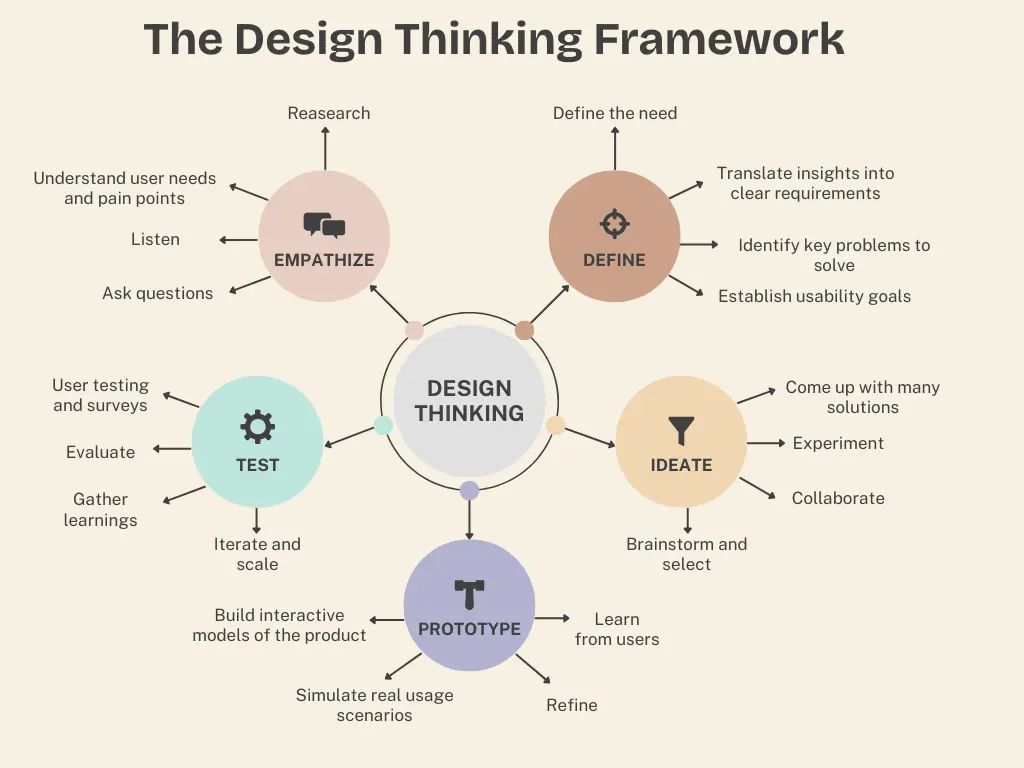
The UCD process is commonly framed in phases that repeat in cycles; it’s an iterative process.
Sustainable product design principles are integrated throughout each phase, while teams actively work to prevent product design mistakes through systematic user validation.
1. Research and Discovery Phase
The initial phase involves extensive user research through ethnographic studies, surveys, and interviews.
Design thinking methodologies guide this exploration, helping teams understand user contexts, needs, and frustrations.
This phase establishes the foundation for all subsequent design decisions and helps avoid common development pitfalls.
2. Analysis and Ideation Phase
Teams analyze research findings to identify patterns and opportunities. Brainstorming sessions generate multiple solutions while design guidelines ensure consistency and feasibility.
Cognitive load theory informs interface decisions, ensuring users can effectively process information.
3. Design and Prototyping Phase
The iterative process becomes important during this phase, where teams create low-fidelity wireframes, progressing to high-fidelity prototypes.
Outsourcing product design teams often collaborate closely with clients during this phase to ensure alignment and prevent costly revisions.
4. Testing and Validation Phase
Comprehensive usability testing validates design decisions through A/B testing, user interviews, and performance metrics.
This phase identifies potential issues before full development, significantly reducing costs and improving user satisfaction.
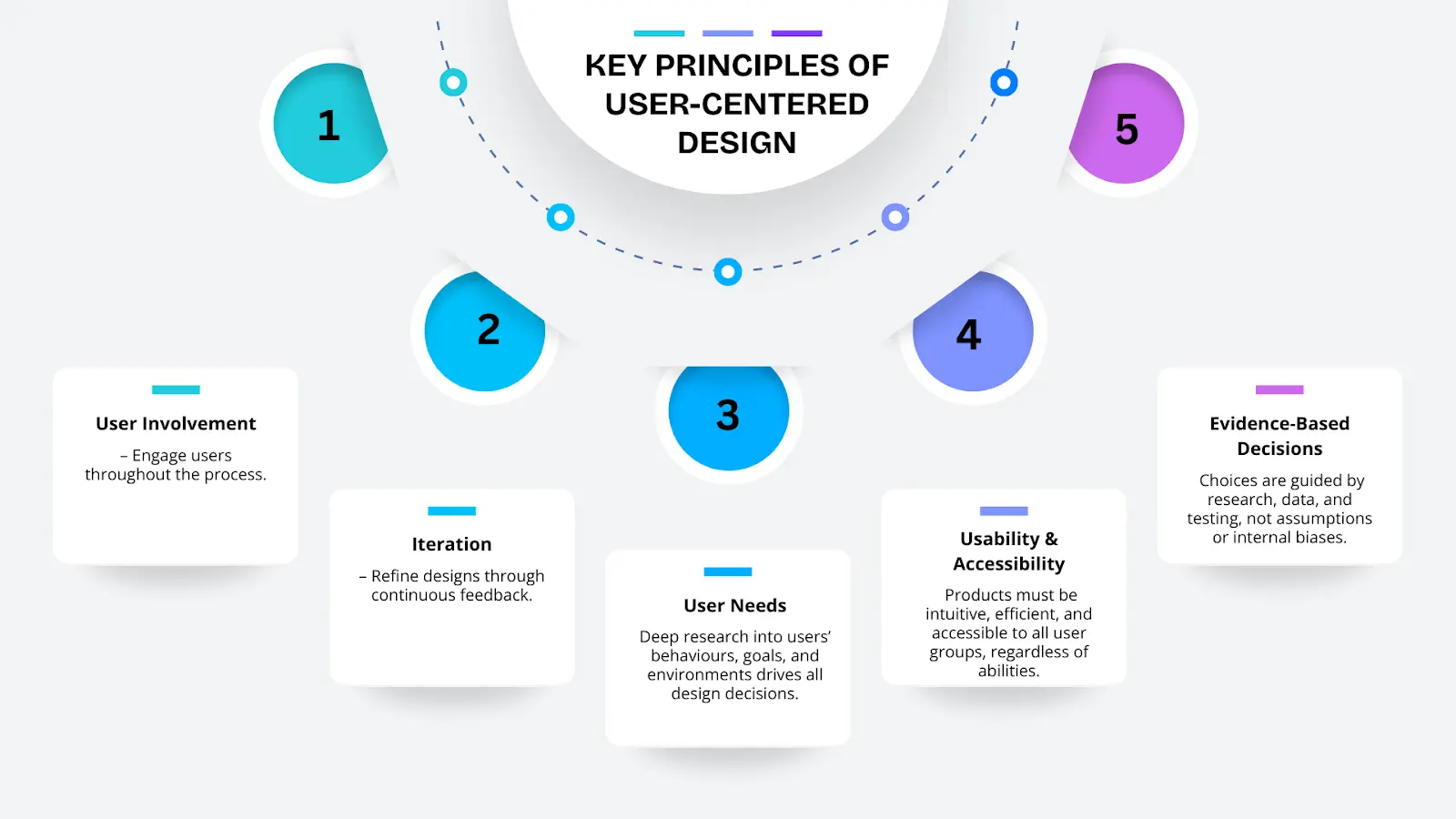
User Focus and Understanding
Every design decision must stem from genuine user insights rather than assumptions. User research methods provide quantitative and qualitative data that inform design guidelines.
Teams conduct regular user interviews, surveys, and observational studies to maintain deep user understanding.
Iterative Design and Testing
The iterative process enables continuous refinement based on user feedback.
Rapid prototyping techniques allow teams to test concepts quickly and economically. This approach helps prevent product design mistakes by identifying issues early in development.
Accessibility and Inclusivity
Sustainable product design inherently includes accessibility considerations, ensuring products serve users with diverse abilities and contexts.
Universal design principles guide interface development to maximize usability across different user groups.
Interactive Design
Understanding how users interact with products in real-world environments influences interface decisions.
Human-computer interaction research informs design choices that account for environmental factors, device limitations, and multitasking scenarios.
Data-Driven Decision Making
UCD relies on practical evidence rather than opinions.
Usability metrics provide objective measures of design effectiveness, while A/B testing validates design alternatives.
Cross-Functional Collaboration
Effective UCD requires collaboration between designers, developers, product managers, and stakeholders.
Brainstorming sessions that include diverse perspectives lead to more innovative solutions while maintaining user focus.
Emotional Design Consideration
Cognitive science research demonstrates that emotional responses significantly impact user experience.
Teams consider both functional and emotional aspects of interaction design to create engaging products.
Got questions about applying these UCD principles? Contact us as we're always up for a good design conversation!
1.Better Product‑Market Fit
Many new products fail (some studies say ~95% of new products miss their mark) largely because they don’t address real user needs.
2.Risk Mitigation
UCD reduces the risk of product design mistakes that can delay projects and waste resources.
By validating assumptions early through the iterative process, teams identify and address issues before they become costly problems.
3.Market Differentiation
In increasingly competitive markets, user experience often becomes the primary differentiator.
Sustainable product design practices that prioritize user satisfaction create lasting competitive advantages.
4.Innovation Driver
Design thinking methodologies promote innovation by encouraging teams to challenge assumptions and explore unconventional solutions.
Brainstorming sessions guided by user insights often reveal opportunities that technologically brilliant approaches might miss.
5.Builds Products People Actually Want
It’s simple: if you’re not designing with your users, you’re guessing. UCD replaces assumptions with insights from brainstorming sessions, usability testing, and cognitive walkthroughs. That creates relevance (and relevance drives adoption).
Only 1 in 20 new products succeed — most fail because they solve the wrong problem or ignore user context.
6.Team Alignment
UCD provides a common framework that aligns cross-functional teams around shared user goals.
Design guidelines based on user research create consistency across products and reduce decision-making conflicts.
Measuring UCD outcomes requires both qualitative and quantitative metrics, and (for sustainable designs) environmental metrics too.
Some approaches include:
A. Usability & Adoption Metrics
✓ Task success rate: Percentage of users completing a task correctly.
✓ Time on task/error rate: How long users take, how many mistakes.
✓ System Usability Scale (SUS) or Net Promoter Score (NPS).
✓ Retention/engagement (in product software) or repeat purchase (in physical products).
✓ Qualitative feedback/interviews /open-ended responses.
B. Sustainable Design Metrics
Especially relevant to sustainable product design, researchers propose four key sustainability metrics at the conceptual stage: Material, production, use, and end of life.
✓ Material: origin, renewability, recyclability.
✓ Production: energy, waste, emissions in manufacturing.
✓ Use: energy consumption during usage.
✓ End of life: ease of disassembly, recyclability, reuse.
You can also combine with manufacturing insights, trade‑off analysis, and life cycle assessment (LCA) tools to quantify environmental impact.
C. Business / ROI metrics
✓ Cost savings from fewer redesigns or customer support load.
✓ Conversion/revenue uplift due to better usability.
✓ Time to market improvements.
✓ Defect/warranty rates reduction.
✓ Sustainability advantage in marketing, regulation compliance, and brand equity.
At iMAC Design & Engineering, we establish a direct approach for these metrics early. Each iteration is evaluated not just on usability scores but also on sustainability KPIs, ensuring we catch product design mistakes early. We then adjust the next cycle.
1. Start with stakeholder alignment & discovery
Bring together product managers, designers, engineers, and business owners for brainstorming sessions.
Define your design guidelines, success metrics, and sustainability goals early (especially if you care about sustainable product design). Conduct user interviews and contextual inquiry to uncover real pain points, not just what you think users want.
2. Create personas, journey maps & mental models
Use cognitive science principles to map how users think and make decisions.
Develop personas and journey maps to guide decisions. Then, run low-fidelity prototypes (sketches, paper mocks) and test them. Use iterative process loops: design → test → refine.
3. Use rapid prototyping + usability testing
Don’t wait to build a polished version. Rapid prototypes help uncover usability flaws early. Conduct moderated usability tests and cognitive walkthroughs.
Measure task success, error rates, and gather qualitative feedback. Use this data to refine; this is the heart of the iterative process.
4. Iterate & scale
Once your MVP is live, collect analytics, heatmaps, session recordings, and usability feedback. Use that data to refine designs continuously. As you scale features, refer back to your design guidelines and principles to maintain consistency. Don’t treat UCD as “done”; it’s ongoing.
1. Access to multidisciplinary expertise
An outsourced team often includes UX researchers, cognitive scientists, UI designers, usability experts, and domain specialists etc.
You don’t have to hire all of them internally. They bring design guidelines, fresh perspectives, and experience avoiding product design mistakes.
2. Faster time to market
Because outsourced teams are ready with the structure and can maximize quickly. Combined with UCD’s iterative cycles, you can test, validate, and iterate faster than if your internal team was trying to manage many roles.
3. Cost efficiency + scalability
With outsourcing, you avoid fixed overheads like facilities and permanent hires, directing resources toward research, prototyping, and user validation.
This flexibility allows you to scale design capacity during high-priority phases, such as usability testing or iterative prototyping and reduce it when workloads ease.
It ensures budgets adapt to project demands without sacrificing the quality or consistency of user-centered design in product development.
4. Shared risk & innovation insulation
A strong outsourced partner often brings lessons and experience from many projects, avoiding disadvantages you might not foresee.
If you embed UCD practices, then they prioritize user outcomes over just fulfilling the requirements, and this practice helps you avoid product design mistakes.
5. Maintaining user alignment
An outsourced partner must work with you to challenge assumptions, ask the right questions, in consideration also ensure that you insist on joint user research, shared prototypes, and feedback loops.
Use tools like remote usability testing, collaborative whiteboards, versioning, and shared dashboards. That way, your outsourced development remains grounded in real user needs.
When you choose product design and development company like iMAC Design & Engineering, we take a UCD-first, hybrid outsourcing approach: we embed your team in every research, brainstorming, prototyping, and evaluation cycle, so your product is user‑aligned from day one.
User-centered design (UCD) is an iterative approach to product development that places the user's needs, behaviours, and motivations at the core of the entire process.
It’s a philosophy that ensures the product is not only functional but also intuitive and easy to use, leading to a better user experience and higher user satisfaction.
Implementing UCD is a continuous, iterative cycle. It involves four key stages that repeat and refine the product based on user feedback.
✓ Understand: Research to deeply understand users, their needs, and their environment.
✓ Specify: Define user and business requirements based on the research findings.
✓ Design: Create and prototype design solutions.
✓ Evaluate: Test the designs with real users to identify and fix usability issues.
Success is measured through both quantitative and qualitative metrics. Quantitative metrics provide objective data, such as task completion rates, time on task, and error rates.
Qualitative metrics offer subjective insights, including user satisfaction scores (e.g., from SUS and NPS surveys), direct user feedback, and observations from usability testing.
User feedback is the lifeblood of UCD. It's used continuously to:
✓ Identify and prioritize user problems.
✓ Validate design decisions and assumptions.
✓ Inform the next iteration of the design, ensuring the product evolves to better meet user needs.

 Download Brochure


