Let Us Help You in Designing Your Product and Launching to Market Contact Us

Mechanical CAD Drafting Services: Process, Benefits, and Industry Applications

Mechanical CAD drafting explained—process, key benefits, and industry applications. Learn how precise CAD documentation improves accuracy, production, and engineering outcomes.

Keshav Bhavsar
30 Dec 2025
3 min

Introduction

Mechanical CAD drafting is the foundation of how engineering ideas are communicated, reviewed, and executed. It connects design intent with dimensional clarity, standards, and technical accuracy that teams across engineering, procurement, and production rely on every day.

This blog explains how mechanical CAD drafting services are structured in practice, what the process looks like in actual engineering environments, and where drafting plays an essential role across industrial applications.

What is Mechnical CAD Drafting?

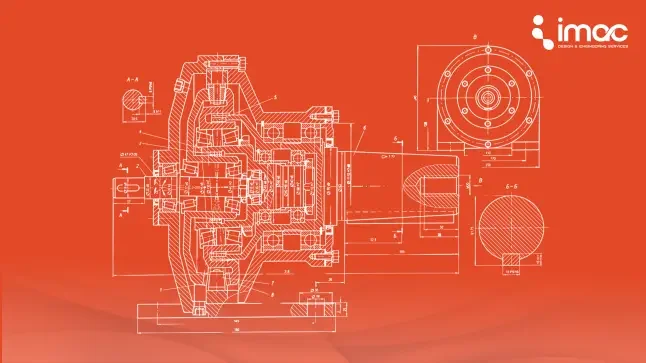
Mechanical CAD drafting focuses on creating technical drawings that show geometry, dimensions, tolerances, and materials consistently.

These drawings are used by:

Engineers for validation

Procurement teams for sourcing

Vendors for pricing

Production teams for execution

The purpose here is not visual representation but technical clarity.

The Process of Mechnical CAD Drafting

1. Technical Requirement Review

Every drafting task begins with understanding:

Component function

Interface conditions

Applicable standards

Manufacturing constraints

This step defines how much detail is required and where precision matters.

2. Draft Creation Using Industry Standards

Drafts are developed using recognized drafting standards, including:

Proper views and sections

Datum references

Tolerance definition where required

Clear annotation and notes

The focus is on consistency and interpretability across teams.

3. Review and Revision Control

Revisions are part of any engineering workflow. Effective drafting includes:

Structured revision tracking

Clear change identification

Alignment between part drawings and assemblies

This prevents version confusion during execution.

4. Final Drawing Release

Approved drawings are released in formats required by downstream teams, including:

2D drawings for fabrication and machining

Assembly drawings

Vendor-specific file formats, when needed

At this stage, drawings become part of the controlled engineering record.

Key Benefits of Mechnical CAD Drafting

1. Improved Interpretation Across Engineering and Vendors

A well-drafted drawing reduces interpretation gaps between teams.

Engineers, vendors, and production personnel do not read drawings the same way. Drafting that follows clear standards ensures:

Dimensions are interpreted consistently

Critical features are identified correctly

Assumptions are minimized during quoting and execution

This directly reduces clarification cycles and prevents discrepancies between intent and output.

2. Controlled Tolerances That Align With Production Capability

Tolerances are one of the most misunderstood elements in engineering documentation.

Practical CAD drafting:

Applies tight tolerances only where function requires them

Keeps non-critical dimensions flexible

Aligns tolerance strategy with actual manufacturing capability

This balance avoids unnecessary machining complexity while preserving part performance.

3. More Reliable Vendor Quotation and Lead Time Planning

Vendors rely on drawings to estimate:

Machining time

Tooling approach

Material usage

Inspection effort

Incomplete or unclear drawings lead to padded quotes and longer lead times.

Accurate CAD drafting supports realistic pricing and predictable scheduling.

4. Reduced Risk During Production and Assembly

Many production issues do not stem from workmanship, but from unclear documentation.

Effective drafting:

Defines reference datums clearly

Supports proper fit and alignment during assembly

Reduces rework caused by dimensional ambiguity

This becomes increasingly important as assemblies grow in complexity.

5. Consistency Across Revisions and Product Variants

Engineering projects evolve. Drawings must evolve with them.

Structured CAD drafting ensures:

Changes are traceable

Previous revisions are not mistakenly reused

Assemblies remain aligned with updated part drawings

This consistency protects both quality and timelines.

6. Long-Term Documentation Value

Drafting is not just for current production.

Accurate drawings support:

Future redesigns

Supplier changes

Spare part manufacturing

Compliance and audit requirements

This long-term usability is often overlooked, but highly valuable.

Why This Matters in Practice? 

In industrial environments, drafting quality influences cost, clarity, and execution stability. We approach CAD drafting with this lifecycle view treating it as a technical control system rather than just a drafting task. This lifecycle approach aligns closely with early-stage product design and development, where manufacturability and documentation quality are established from the start.

Industry Applications of Mechnical CAD Drafting

Aerospace and Tooling - Mold shops and tooling manufacturers depend on precise CAD drawings. Every dimension affects tool performance and part quality.

Medical Device Manufacturing - Regulatory compliance requires documentation. Professional CAD drawings provide the technical proof that your design meets standards.

Injection Molding Design - Before a mold is built, the mold designer needs clear CAD drawings showing cavity dimensions, core positions, and gate locations. Poor drawings mean poor molds. This level of accuracy directly supports downstream plastic injection molding services, where tooling precision determines part quality and repeatability

Custom Parts and Fabrication - Sheet metal, machining, and fabrication shops work from your CAD drawings. The more detailed and accurate, the better your result.

FAQs

1) How is CAD drafting different from mechanical design?

Design defines function and intent. Drafting defines technical communication.

2) Why are tolerances important in drafting?

They control fit, performance, and cost. Incorrect tolerances create downstream issues.

3) When should CAD drafting be outsourced?

When accuracy, speed, and consistency are required without increasing internal workload.

Conclusion

At iMAC Engineering Services, CAD drafting is handled with the same discipline as design itself. The goal is simple: provide documentation that supports consistent execution, predictable outcomes, and long-term usability.

Your design deserves documentation that matches its quality.

Author

Keshav Bhavsar

CEO & Technical Director

Keshav Bhavsar is the CEO and Technical Director of iMAC Design & Engineering Services, bringing over 7 years of expertise in mechanical design and product development. he has successfully led end-to-end product development projects across industries including consumer electronics, medical devices, automotive, and industrial machinery. Under his leadership, iMAC has grown into a trusted partner for startups and enterprises worldwide, delivering innovative design, prototyping, and manufacturing solutions.

One-on-one with iMAC Design & Engineering

Schedule a Consultation
SEND INQUIRY WHATSAPP CALL